Updated 10 November 2026. Advice checked against Tahatū Career Navigator (which replaced careers.govt.nz) and an AUT survey of NZ employers.
Quick answer: A New Zealand cover letter is one page that tells the employer why you want this job and why you’d be good at it, without repeating your CV. Open by naming the role, explain what draws you to the organisation, give two or three examples that match the job ad, and close with your availability. Start with Kia ora or Dear and the hiring manager’s name, and send it as a PDF unless the employer asks for Word. Our two free Word templates below follow this format.
Most NZ job ads ask for a CV and a cover letter, and the cover letter is often what gets your CV opened. This guide covers what NZ employers want in a cover letter, how to write each paragraph, a full example, and how to start and finish it, with extra tips if you’re new to New Zealand or changing careers. Pair it with our New Zealand CV format guide, which has matching CV templates.
On this page
Free NZ cover letter templates (Word)
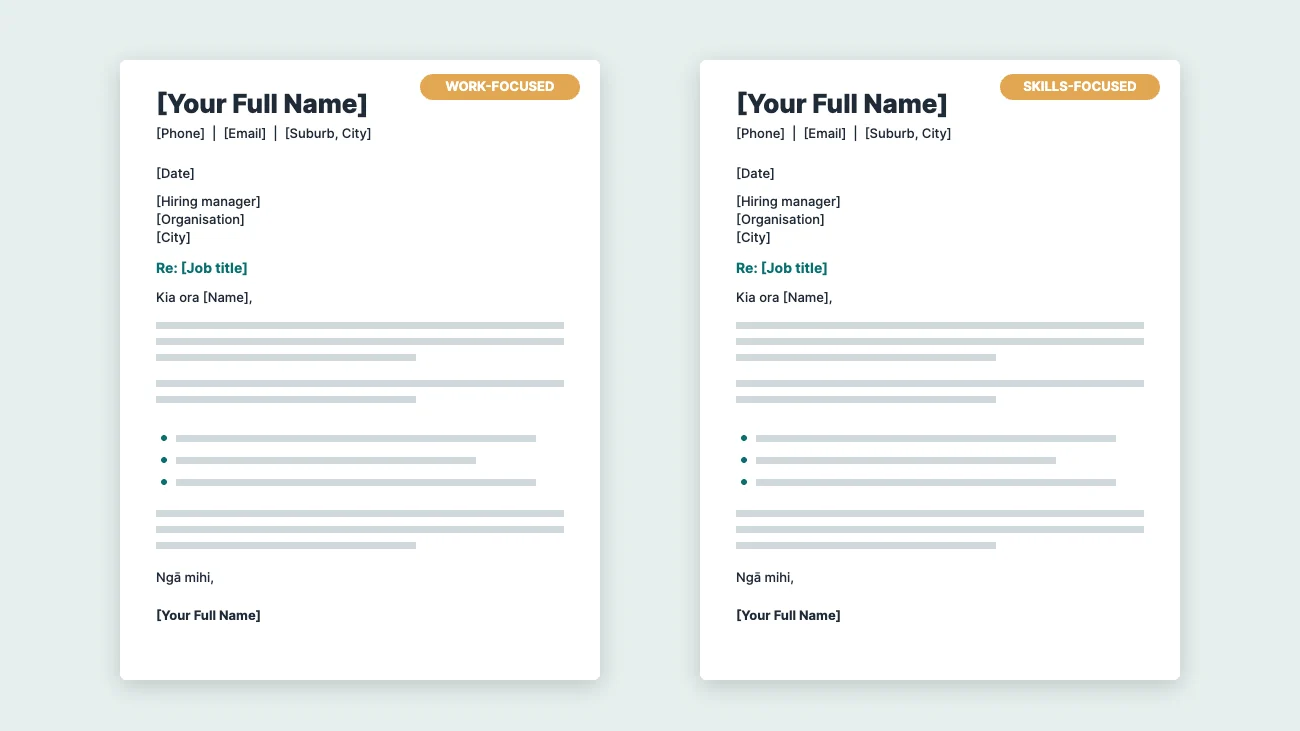
Which one should you use?
- Work-focused template: best if you have steady experience in the same field. It leads with achievements from your current or last job.
- Skills-focused template: best if you’re a school leaver or graduate, changing careers, returning to work, or new to New Zealand. It leads with skills you can prove, from work, study, volunteering or sport, and has a line for your work rights.
Both use the same plain style as our CV templates, so your application looks consistent. Each has a tips page at the end: delete it before you send. They’re free, with no sign-up.
Do NZ employers actually read cover letters?
Mostly, yes. In a survey of NZ employers by AUT’s careers team, 78.5% said they wanted a cover letter, and almost half of those read it before the CV. Tahatū makes the same point: a strong cover letter makes the employer more likely to open your CV.
Not everyone reads them closely. Some recruiters, especially for roles with hundreds of applicants, skim or skip them. But in NZ discussions about job hunting, hiring managers often say they use the cover letter to spot who actually wants the job, as opposed to who is sending the same CV everywhere. An application without one can look low effort, so unless the ad says not to, send one.
NZ cover letter format at a glance
| What NZ employers expect | |
|---|---|
| Length | One page: three or four short paragraphs, plus a few bullet points |
| Layout | Business letter: your details, the date, the employer’s details, then the letter. 62.5% of employers in the AUT survey preferred this layout |
| Font | Plain and readable, such as Calibri 11, in black. No images or graphics |
| Greeting | Kia ora or Dear, plus the hiring manager’s name |
| Sign-off | Ngā mihi or Kind regards, then your full name |
| Language | NZ English spelling (organisation, centre, programme), short sentences |
| File type | PDF, unless the employer asks for Word |
What to write, paragraph by paragraph
1. Your details, the date and the employer’s details
Put your name, phone number, email and suburb at the top. You don’t need your full street address. Then the date, and the hiring manager’s name, job title, organisation and city. A “Re:” line with the job title and any reference number helps the employer file your application.
2. Opening: the job and why it appeals
Name the exact role and where you saw it, say what you do now, and give one honest reason the job appeals to you. Skip openers like “I am writing to apply”: the employer already knows that.
3. Why this organisation
This is the paragraph most people skip, and the one employers notice. Mention something specific you found on their website, LinkedIn or in the news, such as a project, a value they talk about, a new service or a recent award, and why it matters to you. One or two sentences is enough.
4. Your evidence: two or three examples
Pick the two or three most important requirements in the job ad and give an example for each, ideally with a number: money saved, customers served, team size, time saved. Bullet points work well here and help busy readers.
5. How you work, availability and work rights
A sentence on how you work with people, then when you can start. If you’re on a visa, add one sentence on your work rights (see the newcomer tips below).
6. Close
Thank them, say your CV is attached, and finish with a line about the conversation you’d like to have, linked to something from the ad.
Cover letter NZ example
Here’s a full example for a team leader role, using the skills a newcomer with overseas experience would bring. The names are made up.
Ana Rivera
021 123 4567 | ana.rivera@example.com | Hillcrest, Hamilton
3 February 2027
Sam Taylor
Operations Manager
Harbourside Home Supplies
Hamilton
Re: Customer Service Team Leader – ref. CS-204
Kia ora Sam,
I’m applying for the Customer Service Team Leader role advertised on Seek. I spent the last four years in customer service at a large hardware retailer in Manila, the last two leading a team of eight, and I moved to Hamilton with my family in October. This role is a close match for the work I enjoy most: coaching a team and fixing the problems that frustrate customers.
I was drawn to Harbourside because of your focus on trade customers and your new click-and-collect service. In my last role I helped set up a similar service, so I know how much the first few months depend on good communication between the shop floor and the warehouse.
As a team leader, I:
- cut average phone wait times from six minutes to under two by changing how we rostered breaks
- trained 12 new staff, and 10 of them were still in the team a year later
- handled escalated complaints, with a customer satisfaction score of 94% last year
I stay calm on busy days and like teams where people help each other out. I hold a partner work visa with open work rights, valid until March 2029, and I can start immediately.
Thank you for considering my application. My CV is attached, and I’d welcome the chance to talk about how I could help your team as click-and-collect grows.
Ngā mihi,
Ana Rivera
Notice what it does: it names the job, shows real research, backs every claim with a number, and answers the questions a newcomer’s application raises (work rights, start date, overseas experience) before the employer has to ask. It fits on one page.
Kia ora or Dear? How to start and end it
Address the person named in the job ad. If there’s no name, check the company website or LinkedIn, or call and ask. If you still can’t find one, Tahatū suggests “Dear Hiring Manager” or a greeting such as “Kia ora”. Some older guides still suggest “Dear Sir/Madam”, but it reads as dated.
Kia ora or Dear? NZ employers are genuinely split. In the AUT survey, 44.6% preferred “Kia ora” with “Ngā mihi nui”, and 37.5% preferred “Dear” with “Kind regards”. Both are safe. As a rough guide, Kia ora is common in the public sector, education, health and community organisations, and in many other workplaces, while Dear can suit more formal sectors such as law, banking or accounting. If the job ad itself opens with Kia ora, use it.
If you use te reo Māori, spell it correctly, with macrons: Ngā mihi, not Nga mihi. Use first names for most NZ workplaces, and a title and surname (Dear Ms Taylor) only if the organisation is very formal.
Tips for newcomers and career changers
- Mention your work rights in one sentence. Employers have to check you’re entitled to work in New Zealand. Saying your visa type, any conditions and when it expires saves them a step and removes a reason to put your application aside.
- Give your overseas experience context. NZ employers may not know your previous employer. Add its size or what it does, or the NZ equivalent of your job title.
- Explain gaps and changes briefly and positively. One sentence is enough: moving countries, study, caring for family or a career change are all normal reasons.
- Show you’re here and settled, if you are. Your suburb and city in the header help, and so does an NZ phone number.
- Use NZ spelling and plain English. Ask a friend who grew up here to read it. Overly formal language can sound stiff to Kiwi employers.
- Leave personal details out. No photo, date of birth, marital status or religion, the same as for your CV. For other first steps, see our guides to getting a job in New Zealand and getting an IRD number.
Using AI to write your cover letter
AI tools can give you a first draft in seconds, and Tahatū says that’s fine as a starting point. But employers in the AUT survey said they don’t want fully AI-generated letters: they can spot them, and they don’t tell them anything about you.
- Give the tool the real job ad and your real experience, not a vague prompt.
- Rewrite the result in your own words. Cut anything that sounds like a sales brochure.
- Check every claim. AI tools sometimes invent achievements, numbers or company details.
- Add the specific research and examples only you can provide.
Common cover letter mistakes
- Sending the same letter to every employer. Employers notice generic letters straight away.
- Repeating your CV. Pick the highlights and add the why.
- Going over one page. If it doesn’t fit, cut words, not the font size.
- The wrong company name or job title. A common slip when reusing a letter, and an easy reason to be rejected.
- Ignoring instructions in the ad. If it asks you to address certain criteria or quote a reference number, do it.
- Talking only about what you want. Show what you’d bring to them as well.
- Typos. Read it aloud, then ask someone else to check it.
How to send your cover letter
- Save it as a PDF unless the employer asks for Word, so your formatting doesn’t change.
- Name the file clearly, for example Ana-Rivera-Cover-Letter.pdf, not CoverLetter_final2.docx.
- Applying by email? In the AUT survey, 68% of employers preferred the cover letter as an attachment. Tahatū suggests pasting the letter into the email as well and attaching both the PDF letter and your CV.
- Applying on Seek or Trade Me Jobs? Upload it in the cover letter field, or paste it in if there’s only a text box. Check the formatting before you submit.
Once you’ve got an offer, our guide to average salaries by industry can help you check the pay is fair.
Got the job? Our NZ resignation letter guide has three free Word templates in the same style, plus how much notice to give and what happens to your final pay.
FAQs
How long should a cover letter be in NZ?
One page. Tahatū, the government careers site that replaced Careers NZ, recommends keeping it to a single page, which usually means three or four short paragraphs plus a few bullet points.
Do I need a cover letter for every job in New Zealand?
Yes, unless the ad says not to send one. In an AUT survey, 78.5% of NZ employers wanted a cover letter, and many hiring managers use it to see who genuinely wants the job.
Should I start my cover letter with Kia ora?
You can. NZ employers are split: in an AUT survey, 44.6% preferred Kia ora with Ngā mihi nui, and 37.5% preferred Dear with Kind regards. Both are fine, so match the tone of the organisation.
What if I can’t find the hiring manager’s name?
Check the job ad and the company website, or call and ask. If you still can’t find a name, use Dear Hiring Manager or Kia ora. Avoid Dear Sir/Madam, which reads as dated.
Should I mention my visa in a cover letter?
If you’re not a New Zealand citizen or resident, yes, briefly. One sentence with your visa type, any conditions and when it expires tells the employer you can legally do the job.
Can I use AI to write my cover letter?
You can use it to get started, but rewrite it in your own words and check every fact. NZ employers say they can spot fully AI-written letters and don’t want them.
Should I send my cover letter as a PDF or Word file?
Send a PDF unless the employer asks for Word. Name the file with your name and “cover letter”, and if you’re applying by email, attach it along with your CV.
What’s the difference between a CV and a cover letter?
Your CV lists your experience, skills and education. Your cover letter explains why you want this particular job and picks out the two or three things that make you a good fit, with examples.
Sources
- Tahatū Career Navigator – How to write a cover letter
- AUT – The value of a cover letter according to employers
- Trade Me Jobs – What to include in a NZ cover letter (2023)
- r/newzealand – discussion of Seek applications and cover letters (January 2026)
This guide is general information. Hiring practices vary by employer and industry, so always follow the instructions in the job ad.

Written by Alex · Founder, NZ Life Help
Alex moved to New Zealand from the UK in 2019 and has lived in Auckland and the South Island. He started NZ Life Help in 2026 to give newcomers and locals the clear, practical answers he couldn’t find when he arrived. Guides are checked against official sources and updated when the rules change.