
Updated 8 November 2026. Checked against advice from Careers New Zealand and Immigration New Zealand.
Quick answer: A standard New Zealand CV format is 2–3 pages, in reverse-chronological order: contact details, a short profile, key skills, work experience, education, and two referees with their contact details. Leave out your photo, date of birth and marital status. Tailor it to every job ad, keep the layout plain so recruitment software can read it, and save it as both Word and PDF.

A Kiwi CV is shorter and more practical than in many countries. Employers want to see quickly whether you can do the job, so everything on it should point to that. Below you’ll find two free Word templates that follow the New Zealand CV format, a full example, and section-by-section guidance, including tips if you’re new to New Zealand.
On this page
Free New Zealand CV templates (Word)
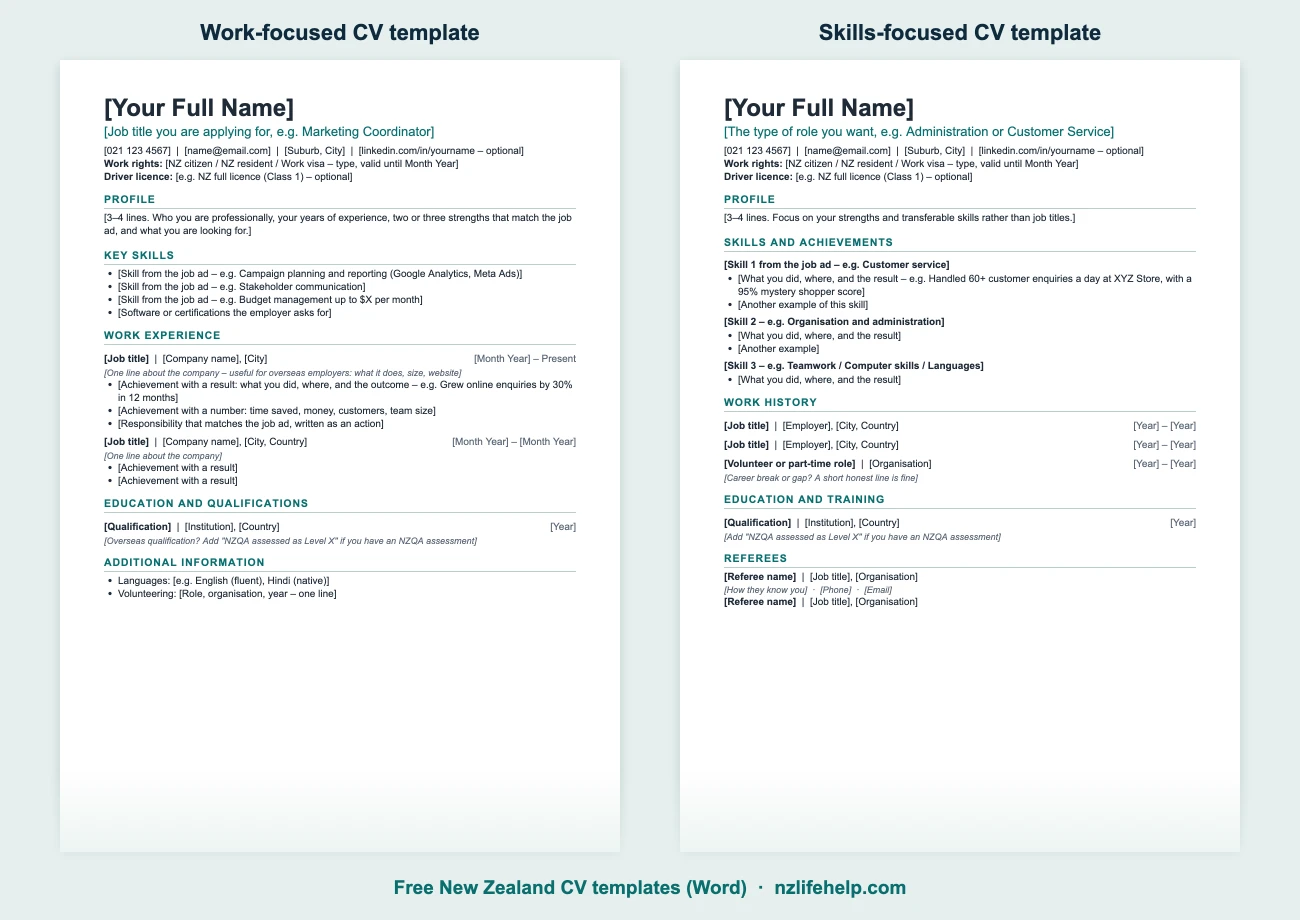
Which one should you use?
- Work-focused template: best if you have steady experience in one field and want to show career progression, for example applying for a similar or more senior role.
- Skills-focused template: best if you’re changing careers, new to New Zealand, a recent graduate, or have gaps in your work history. It leads with what you can do, backed by examples.
Both follow the New Zealand CV format recommended by Careers NZ: plain, single-column layouts with no tables, text boxes or images, so they work with the recruitment software many NZ employers use. Each one includes a final tips page, so delete it before you send your CV. They’re free to use, and you don’t need to sign up.
CV or resume in New Zealand?
In New Zealand, “CV” and “resume” mean the same thing: a short document summarising your skills and experience. Most people say CV. The long academic-style CV is only used for research and university jobs. If a job ad asks for a resume, send the same NZ-style CV.
New Zealand CV format at a glance
| What | The NZ standard |
|---|---|
| Length | 2–3 pages. One page can work for school leavers and some graduates. |
| Order | Contact details → profile → skills → work experience (most recent first) → education → extras → referees |
| Font | A plain font such as Arial or Calibri, around 11 pt |
| Layout | Single column, headings, bullet points and white space. No tables, boxes, columns or images |
| Photo | Leave it out |
| Age, date of birth, marital status | Leave them out |
| Address | Suburb and city is enough |
| Referees | Two, with name, job title, relationship to you, phone and email |
| File type | Save both Word and PDF and send whichever the ad asks for. If it doesn’t say, Word is the safer choice |
| Spelling | New Zealand English: organised, centre, programme, licence (noun) |
New Zealand CV format: what to include, section by section
1. Contact details
Your name, mobile number, email address, and suburb and city. A LinkedIn profile is optional but worth adding if it’s up to date. Careers NZ suggests listing the number you’re easiest to reach on and checking your voicemail greeting sounds professional. Use a sensible email address based on your name.
2. Work rights (if you’re not a citizen or resident)
Many employers want to know straight away whether you can legally work for them. One line under your contact details does it: for example, “Work rights: Accredited Employer Work Visa, valid until March 2028” or “Work rights: NZ resident”. Only state what your visa actually allows.
3. Profile
Three or four lines at the top that sum up who you are, your main strengths and the kind of role you want. Rewrite it for each job so it reflects what that ad asks for. Skip vague phrases like “hard-working team player” unless you back them up with an example.
4. Key skills
List the skills, software and certifications the job ad asks for, using the same words as the ad. Careers NZ recommends going further than a list: for each important skill, show what you did, where, and the result. For example:
- Weak: Customer service
- Strong: Served 60+ customers a day at Books & Co, Wellington, and achieved a 95% mystery shopper score.
5. Work experience
List your jobs with the most recent first: job title, employer, location and dates (month and year). Under each, write three or four bullet points that start with an action and include a result where you can, such as numbers, money, time saved, customers or team size. Focus on roughly the last 10 years and sum up older jobs in a line or two.
If you worked overseas, Immigration New Zealand suggests adding a one-line description of each employer (what it does, its size and its website), since NZ employers may not know the company.
6. Education and qualifications
Your highest or most relevant qualifications first, with the institution and year. If you studied overseas and have had your qualification assessed by NZQA, add the NZ equivalent level, for example “NZQA assessed as Level 7”. Leave out high school details unless you’re a recent school leaver.
7. Extras (optional)
Only include extras if they help: languages, a driver licence (useful for many trades, sales and field jobs), volunteering, professional memberships or relevant courses. A line on community involvement can help, especially if you’re new to the country.
8. Referees
This is where many CVs go wrong. Careers NZ says most New Zealand employers ask for two referees, so list them with their name, job title, organisation, how they know you, phone number and email. Ask your referees first, check their details are current, and tell them about the jobs you’re applying for. A recent manager is the strongest choice.
What to leave off your CV
- A photo
- Your age or date of birth
- Marital status, children, religion, political views, health details or sexual orientation
- Your full street address (suburb and city is enough)
- ID numbers such as your passport, IRD or driver licence number
- Reasons for leaving each job, and your salary history
- Unrelated hobbies or long lists of every course you’ve done
Most of this has nothing to do with whether you can do the job. Under the Human Rights Act, employers generally shouldn’t ask about things like age, religion or sexual orientation when hiring, as Employment New Zealand explains. Leaving them off keeps the focus where it belongs.
New Zealand CV format example
Here’s a shortened page one that follows the New Zealand CV format, using our work-focused template. The person and companies are fictional.
Sarah Thompson
Marketing Coordinator
021 123 4567 | sarah.thompson@example.co.nz | Grey Lynn, Auckland | linkedin.com/in/sarahthompson-nz
Work rights: NZ citizen
PROFILE
Marketing coordinator with 6 years’ experience in digital campaigns for NZ retail brands. Known for clear reporting and campaigns that deliver measurable results. Looking for a senior marketing role in Auckland.
KEY SKILLS
- Campaign planning and reporting (Google Analytics 4, Meta Ads, Google Ads)
- Email marketing and CRM (HubSpot, Mailchimp)
- Budget management up to $8,000 a month
- Content writing in New Zealand English
WORK EXPERIENCE
Marketing Coordinator | Kōwhai Retail Ltd, Auckland | March 2023 – present
- Grew Instagram followers by 12,000 in 18 months through a weekly content plan
- Lifted email open rates from 19% to 28% by segmenting the customer list
- Managed an $8,000 monthly Google Ads budget, achieving 4.2× return on ad spend
Marketing Assistant | Harbour Software, Wellington | January 2021 – February 2023
- Coordinated six product launches, including events, emails and social media
- Built monthly reporting dashboards used by the leadership team
EDUCATION
Bachelor of Commerce (Marketing), University of Auckland, 2020
REFEREES
James Wilson, Marketing Manager, Kōwhai Retail Ltd (current manager) – 021 987 6543 – james.wilson@example.co.nz
Priya Patel, Head of Product, Harbour Software (former manager) – 022 456 7890 – priya.patel@example.co.nz
Notice what makes it work: every bullet has a result, the skills match the kind of job she wants, and there’s nothing personal that the employer doesn’t need. That’s the New Zealand CV format in a nutshell.
Word or PDF: how to send your CV
Follow the job ad. If it asks for a PDF, send a PDF. If it asks for Word, send Word. Careers NZ recommends saving your CV in both formats because employers may ask for either. Its job application checklist suggests Word when you’re applying through recruitment software, since some systems read Word files more reliably than PDFs.
Name the file clearly with your name, the job and the date, for example Jane-Smith-CV-Marketing-Coordinator-2026-11.docx, so it doesn’t get lost among a hundred files called “CV”.
Make your CV easy for recruitment software to read
Many employers, recruitment agencies and job sites use applicant tracking systems (ATS) to sort CVs. Based on Careers NZ’s checklist:
- Use a plain layout with clear headings like “Work experience” and “Education”.
- Avoid tables, text boxes, columns, shading, images and graphics.
- Don’t put important details (such as your name or phone number) in the header or footer.
- Use the job ad’s exact words for job titles, skills and software.
- Avoid abbreviations the system might not recognise, and write out terms in full at least once.
CV tips for migrants and newcomers
- Show your work rights clearly near the top.
- Explain overseas employers in one line each.
- Get NZ referees if you can. Careers NZ suggests entry-level or volunteer work as a way to gain local experience and referees.
- Get your qualifications assessed by NZQA if employers in your field are likely to ask what they’re equivalent to.
- Use a NZ mobile number as soon as you have one, so employers can reach you easily.
- Adjust your tone. Immigration NZ notes that Kiwi employers like you to present yourself well without sounding boastful. Let results speak for themselves.
- Have certified copies of qualifications ready. A Justice of the Peace (JP) can certify copies for free.
Looking for work right now? Our guide to getting a job in New Zealand covers where to search, and you’ll need an IRD number before your first pay day.
Common New Zealand CV format mistakes
- Using an overseas format with a photo, date of birth and long personal section.
- Listing duties instead of achievements. “Responsible for social media” says less than “grew followers by 12,000”.
- Writing “references available on request” instead of naming two referees.
- Sending one generic CV to every job. Tailor the profile, skills and top bullets each time.
- Fancy templates with columns, icons and skill bars that recruitment software can’t read.
- US or UK spelling, and typos. Ask someone to proofread it.
- No cover letter. Most NZ employers expect one, kept to a single page.
Don’t forget the cover letter
Most New Zealand employers expect a cover letter with your CV. Keep it to one page: who you are, why you want this job, and two or three examples that match what the ad asks for. Our guide to how to write a cover letter in NZ has a full example and two free Word templates that match the CV templates above, and Tahatū (which replaced Careers NZ) has more examples.
Weighing up an offer? Check our guides to the minimum wage in New Zealand and average salaries by industry, and if you’re moving cities, the cost of living in New Zealand.
Got the new job? When you’re ready to hand in your notice, use our free NZ resignation letter templates, with a guide to notice periods and final pay.
FAQs
How long should a CV be in New Zealand?
Usually 2–3 pages, according to Careers New Zealand. School leavers and some graduates can fit everything on one page. Put the most relevant information on page one.
What is the standard CV format in New Zealand?
Contact details, a short profile, key skills, work experience with the most recent job first, education, optional extras such as languages or a driver licence, and two referees. Use a plain single-column layout with clear headings.
Should I put a photo on my CV in New Zealand?
No. NZ employers don’t expect a photo, and leaving it off keeps the focus on your skills and experience.
Do I need to include referees on my NZ CV?
Yes. Most NZ employers ask for two referees, so list their name, job title, organisation, how they know you, phone number and email. Ask them first.
Should I send my CV as a Word document or PDF?
Send whatever the job ad asks for. Save your CV in both formats. If the ad doesn’t say, Word is often the safer choice for recruitment software.
Where can I get a free NZ CV template?
You can download our free work-focused template or skills-focused template in Word. Careers New Zealand also offers free templates.
Should I include my visa status on my CV?
If you’re not a NZ citizen or resident, yes. Add one line near the top stating your work rights, for example the visa type and expiry date.
How do I write a CV with no New Zealand experience?
Use the skills-focused format, explain your overseas employers briefly, highlight transferable skills with examples, and consider volunteer or entry-level work to gain local experience and referees.
Sources
- Careers New Zealand – How to write a NZ-style CV
- Careers New Zealand – Job application checklist
- Careers New Zealand – CV and cover letter templates
- Immigration New Zealand (Live and Work) – Develop a NZ-style CV
- Employment New Zealand – Discrimination when hiring

Written by Alex · Founder, NZ Life Help
Alex moved to New Zealand from the UK in 2019 and has lived in Auckland and the South Island. He started NZ Life Help in 2026 to give newcomers and locals the clear, practical answers he couldn’t find when he arrived. Guides are checked against official sources and updated when the rules change.