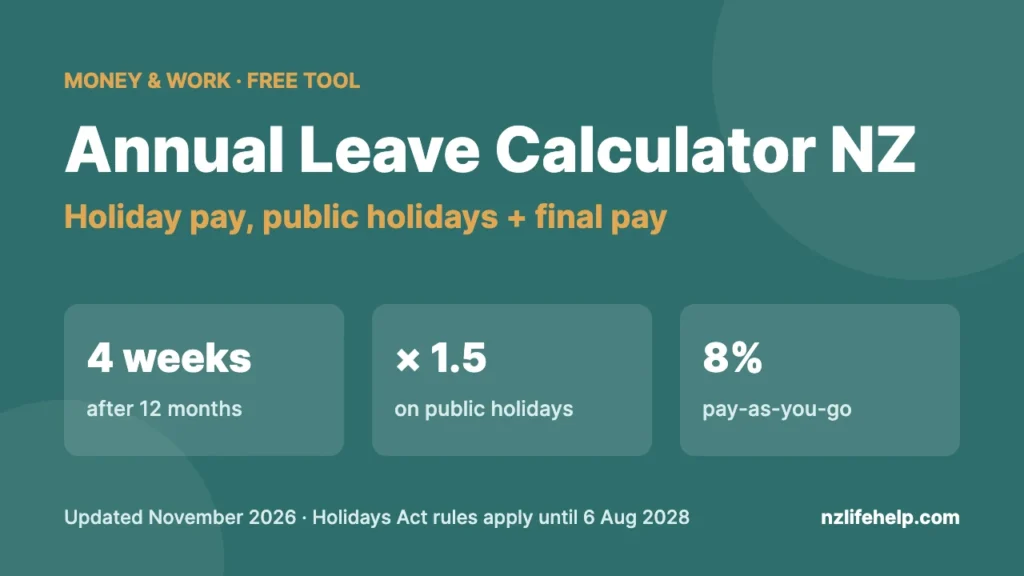
This annual leave calculator NZ tool works out the three holiday pay sums people most often get wrong: what a week of leave should pay you, what you’re owed for working a public holiday, and how much holiday pay belongs in your final pay. The rules come from the Holidays Act 2003 and are the same everywhere in New Zealand. Your employment agreement can give you more, but never less.
Quick answer: You get at least 4 weeks’ paid annual leave after 12 months with the same employer. Each week of leave pays the higher of your ordinary weekly pay or your average weekly earnings over the last 12 months (gross earnings ÷ 52). Working a public holiday pays at least time and a half, plus a day in lieu if it’s a day you’d normally work. These rules apply until the new Employment Leave Act starts on 6 August 2028.
NZ holiday pay calculator (Holidays Act rules)
Pick what you want to work out. Uses the current Holidays Act 2003 rules, which apply until 6 August 2028.
Estimates before tax, using the minimums in the Holidays Act 2003. Your employment agreement can give you more, never less. Average weekly earnings = gross earnings for the last 12 months ÷ 52. Gross earnings include overtime, allowances, commission and holiday pay, but not things like reimbursements or discretionary bonuses. Not legal advice: check with Employment New Zealand (0800 20 90 20) if you think you’ve been underpaid.
How much annual leave do you get in NZ?
Every employee becomes entitled to at least 4 weeks of paid annual leave after 12 months of continuous work for the same employer, and another 4 weeks after each year after that. Public holidays are separate and don’t come out of your leave.
A “week” means your normal working week. If you work five 8-hour days, 4 weeks is 20 days. If you work three 8-hour days, a week is 3 days (24 hours), so your 4 weeks is 12 days. If your hours change from week to week, you and your employer can agree on how to define a week in days or hours.
- Leave doesn’t expire. It stays available until you take it or it’s paid out.
- You can take leave early (before you’re entitled to it) if your employer agrees.
- Your employer must let you take leave when you want to unless they have a good reason not to, and can require you to take it in some situations, such as an annual Christmas closedown.
- You’re paid before you go, unless you’ve agreed to be paid in your normal pay cycle.
- 5 weeks or more is something some employers offer, but the legal minimum is 4.
How to calculate annual leave pay
When you take annual leave, you must be paid at least the greater of two amounts:
| Measure | What it is | How it’s worked out |
|---|---|---|
| Ordinary weekly pay (OWP) | What you normally get for a usual working week | Regular wages or salary, plus regular allowances, regular overtime, regular commission and the cash value of board or lodgings |
| Average weekly earnings (AWE) | Your average over the last 12 months | Gross earnings for the 12 months before your leave ÷ 52 |
Example: your contract pays $1,200 a week, but with overtime and allowances you earned $66,000 over the past year. Your average weekly earnings are $66,000 ÷ 52 = $1,269.23. That’s higher than $1,200, so a week of leave should pay $1,269.23. Over 4 weeks, that’s $277 more than the contract rate.
This is where mistakes happen. If you do regular overtime, earn commission or had a pay rise during the year, check your holiday pay against both numbers. If your hours vary so much that OWP can’t be worked out, your employer uses a formula instead: your gross earnings for the last 4 weeks, minus any one-off payments, divided by 4.
Public holiday pay: time and a half and a day in lieu
If you work on a public holiday, you must be paid at least time and a half for the hours you work (or your agreement’s special public holiday rate if that works out higher). If the holiday falls on a day you’d normally work (an “otherwise working day”), you also get an alternative holiday: a paid day off to take later.
Example: on $25 an hour, an 8-hour shift on Christmas Day pays at least $25 × 8 × 1.5 = $300, plus a day in lieu if Friday is normally a work day for you.
- If the holiday is a normal working day and you don’t work, you get the day off on your normal pay.
- Your employer can only make you work a public holiday if it’s a day you’d normally work and your employment agreement says you can be required to.
- You can claim at most 12 public holidays a year, and no more than 4 over Christmas and New Year.
Over the 2026/27 summer: Christmas Day is Friday 25 December. Boxing Day falls on Saturday 26 December, so if you don’t normally work Saturdays it moves to Monday 28 December. New Year’s Day is Friday 1 January 2027, and the day after New Year’s Day (Saturday 2 January) moves to Monday 4 January. See every date in our public holidays NZ 2027 guide, and what’s trading in what’s open on Christmas Day.
Holiday pay in your final pay
When you leave a job, your final pay must include all the holiday pay you’re owed. It has to be paid on or before the payday for your final pay period. How it’s worked out depends on how long you’ve been there:
| Time with the employer | Holiday pay you’re owed |
|---|---|
| Less than 12 months | 8% of your gross earnings since you started, minus any holiday pay already paid (for leave taken in advance or pay-as-you-go) |
| 12 months or more | Your unused leave, paid at the higher of OWP or AWE, plus 8% of your gross earnings since your last work anniversary, minus anything already paid in advance |
One detail catches people out at Christmas: your unused leave is treated as if you took it straight after your last day. If a public holiday falls in that time, and it’s a day you’d normally have worked, you must be paid for the public holiday too, and your leave period is pushed out by a day. Leave just before Christmas with a week of leave owing, and you could be paid for Christmas Day, Boxing Day and the New Year holidays as well.
Handing in your notice? Our resignation letter templates cover notice periods and what to ask about your final pay.
Pay-as-you-go holiday pay (8%)
Instead of 4 weeks off, some employees get an extra 8% (or more) on top of every pay. This is only allowed if you’re on a genuine fixed-term agreement of less than 12 months, or you work so irregularly that it isn’t practical to give you 4 weeks’ leave. It must be agreed in your employment agreement and be an identifiable amount of your pay, ideally shown separately on your payslip.
Being called “casual” isn’t enough on its own. Employment New Zealand says it’s your actual work pattern that counts. If you’ve been working regular, predictable hours for months on 8% holiday pay, it’s worth asking whether you should be getting paid annual leave instead.
Cashing up annual leave
Once you’re entitled to annual leave, you can ask to cash up (get paid out instead of taking time off) up to 1 week of your 4 weeks each year. The request must be in writing and can be made in one go or in several parts. Your employer can say no, and some workplaces have a policy of not allowing it. Your employer can’t pressure you into cashing up.
Sick leave in brief
After 6 months with an employer, you’re entitled to 10 days of paid sick leave a year, for yourself or to care for a partner, child or other dependant. Unused sick leave carries over, up to a maximum balance of 20 days. Sick leave is separate from annual leave, so your employer can’t simply take sick days out of your holiday balance.
What changes in 2028 (the Employment Leave Act)
The Employment Leave Act 2026 became law in August 2026 and will replace the Holidays Act on 6 August 2028. Until then, the current rules (and this calculator) apply. Employment New Zealand is clear that employers can’t switch to the new rules early, even if you both agree.
The main changes:
- Annual and sick leave will build up in hours from your first day, instead of arriving in weeks after 12 months (or days after 6 months).
- Annual leave will accrue at 0.0769 hours for every standard hour you work (roughly 4 weeks a year for a full-time worker). Sick leave will accrue at 0.0385 hours per standard hour, capped at 160 hours.
- Leave will be paid at a single hourly rate, rather than the OWP versus AWE comparison.
- You’ll still be able to ask to cash up to 1 week of annual leave a year.
Your employer should talk to you about changes to your employment agreement and how your leave balance will convert before August 2028. We’ll update this page and the calculator as Employment New Zealand publishes its guidance.
Holiday pay and tax
Holiday pay is taxed through PAYE like the rest of your wages, and KiwiSaver and student loan deductions apply too. A big lump sum, like a final pay with leave paid out, can look heavily taxed on the payslip. If too much tax comes off over the year, IRD refunds it after the tax year ends. To see what your regular pay looks like after tax, use our take-home pay calculator.
Think you’ve been underpaid?
- Ask your employer or payroll team how your holiday pay was worked out. Employers must keep holiday and leave records, and you can ask to see yours.
- Compare their figures with both OWP and AWE using the calculator above.
- If you can’t sort it out, contact Employment New Zealand on 0800 20 90 20. They can explain your rights and point you to free mediation.
Earning close to the minimum? Our minimum wage guide has the current rates.
Need to count working days rather than leave days? Try our working days calculator, which includes every public holiday and regional anniversary day.
Frequently asked questions
How many days of annual leave do you get in NZ?
At least 4 weeks a year after 12 months with the same employer. If you work a 5-day week, that is 20 days. Public holidays are on top of this and don’t come out of your annual leave.
How is annual leave pay calculated in NZ?
You must be paid the higher of your ordinary weekly pay or your average weekly earnings for the last 12 months (your gross earnings divided by 52). If you do regular overtime or earn commission, average weekly earnings are often the higher figure.
Do I get time and a half on public holidays?
Yes. If you work on a public holiday you must be paid at least time and a half for the hours you work. If the holiday falls on a day you would normally work, you also get an alternative holiday (a paid day in lieu) to take later.
Can I cash out annual leave in NZ?
You can ask in writing to cash up to 1 week of your annual leave each year once you are entitled to it. Your employer can decline, and some workplaces don’t allow it, but they can’t pressure you into it.
What happens to my annual leave when I resign?
Unused leave is paid out in your final pay. If you have been there 12 months or more, you get your unused leave at the higher of ordinary weekly pay or average weekly earnings, plus 8% of what you have earned since your last work anniversary. Under 12 months, you get 8% of your gross earnings.
Do casual workers get holiday pay in NZ?
Usually as pay-as-you-go: at least 8% of gross earnings added to each pay. This is only allowed if your work is genuinely irregular or you are on a fixed-term agreement of under 12 months. Being called casual is not enough on its own.
When do the new leave rules start?
The Employment Leave Act 2026 replaces the Holidays Act on 6 August 2028. Until then, the current Holidays Act rules apply, and employers can’t switch to the new rules early.
Sources
- Employment New Zealand: taking annual holidays
- Employment New Zealand: annual holiday pay
- Employment New Zealand: public holiday rights for employees
- Employment New Zealand: final pay
- Employment New Zealand: pay-as-you-go holiday pay
- Employment New Zealand: cashing up annual holidays
- Employment New Zealand: sick leave
- Employment New Zealand: changes to leave coming in 2028
- Business Canterbury: Employment Leave Act 2026 summary
Last checked 15 November 2026 against Employment New Zealand guidance. This is general information, not legal advice. For your own situation, check your employment agreement or contact Employment New Zealand.

Written by Alex · Founder, NZ Life Help
Alex moved to New Zealand from the UK in 2019 and has lived in Auckland and the South Island. He started NZ Life Help in 2026 to give newcomers and locals the clear, practical answers he couldn’t find when he arrived. Guides are checked against official sources and updated when the rules change.