Updated 11 November 2026. Rules checked against Tenancy Services and the Disputes Tribunal.
Flatmate agreement NZ, the quick answer: if you live in a rental but aren’t named on the tenancy agreement, you’re a flatmate, and the Residential Tenancies Act doesn’t cover you. Your rights come from whatever you agree with the head tenant, so put it in writing: rent, bond, bills, notice to leave and house rules. Disagreements between flatmates go to the Disputes Tribunal, not the Tenancy Tribunal. Download our free Word templates below.
Most flatting arguments come down to the same few things: who pays which bill, how much notice someone has to give, whether the bond comes back, and whose partner is basically living there. A written flatmate agreement sorts those out before they become a problem. Here’s what to include, how the rules work for head tenants and flatmates, and two free templates you can edit in Word or Google Docs.
Free flatmate agreement template NZ (Word)
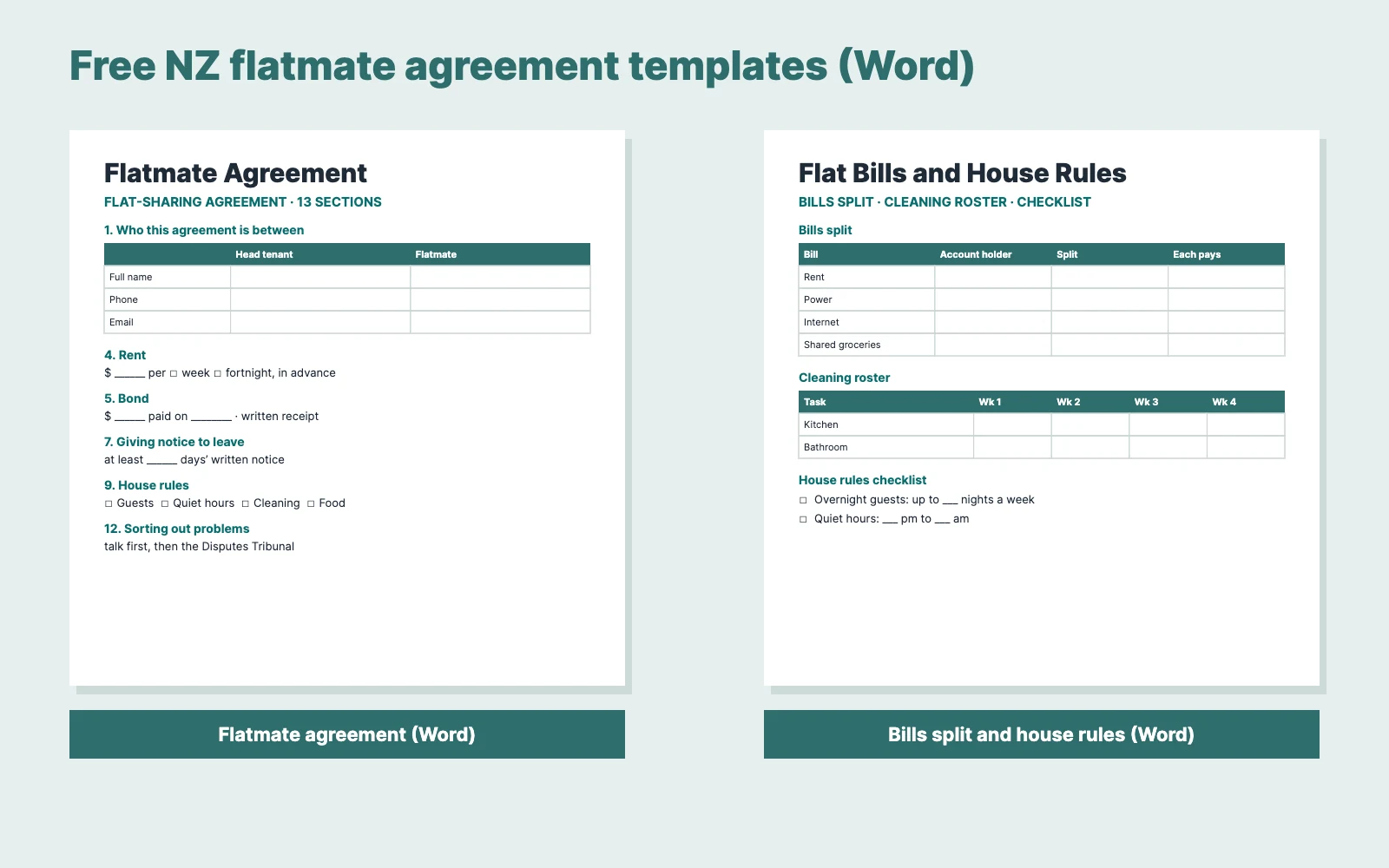
- Flatmate agreement: a full flat-sharing agreement in 13 short sections: who it’s between, the room, start date, rent, bond, bills, notice, landlord notices, house rules, damage and insurance, moving out, sorting out problems, and signatures. It ends with a “before you sign” checklist page to delete.
- Bills split and house rules sheet: a bills table (provider, account holder, split and each person’s share), a flat kitty, a four-week cleaning roster and a house rules checklist everyone signs. Useful for the whole flat, even if you already have an agreement.
Tenancy Services also has a short official flat/house sharing agreement (PDF). It covers the basics in 11 clauses. Ours adds the things that usually cause arguments: guests and partners, cleaning, how bills are split, landlord notices and what happens if the tenancy ends.
Tenant or flatmate? Why it matters
According to Tenancy Services, the Residential Tenancies Act 1986 only covers tenants and landlords, not flatmates. Which one you are depends on one thing: whether your name is on the tenancy agreement.
| Tenant | Flatmate | |
|---|---|---|
| Signed the tenancy agreement with the landlord | Yes | No |
| Covered by the Residential Tenancies Act | Yes | No |
| Responsible to the landlord for rent and damage | Yes, jointly with other tenants, for all of it | No, responsible to the tenant for their share |
| Who can give them notice to leave | Only the landlord | The head tenant, under your agreement |
| Where disputes go | Tenancy Tribunal (with the landlord) | Disputes Tribunal (with the head tenant) |
If everyone in the flat signs the tenancy agreement, you’re all tenants, and if one person causes damage or falls behind on rent, the others can be held responsible. If only one or two people sign, they’re the head tenants, and everyone else is a flatmate living there under a private agreement with them.
Flatmate agreement NZ: what to include
- Names and contact details of the head tenant and the flatmate, and an emergency contact.
- The room and which shared areas and furniture the flatmate can use.
- Start date, and whether it’s ongoing or for a fixed period.
- Rent: the amount, how often, paid in advance, and the bank account. Add how rent changes will be passed on if the landlord puts the rent up.
- Bond: the amount, a receipt, when it’s returned and what can be deducted.
- Bills: which bills are shared, whose name each account is in, and how they’re split.
- Notice to leave: how many days’ written notice each side must give.
- Landlord notices: the head tenant passes on any notice from the landlord straight away.
- House rules: guests, partners, quiet hours, smoking, pets, cleaning and food.
- Damage and insurance: who pays for damage, and a reminder that flatmates need their own contents insurance.
- Moving out: cleaning, keys, final bills and getting the bond back.
- Sorting out problems: talk first, then the Disputes Tribunal.
How much notice should a flatmate give?
Because flatmates aren’t covered by tenancy law, there’s no legal notice period. It’s whatever you agree. Tenancy Services’ sample agreement uses 14 days’ written notice for either side, which is a sensible starting point. Some flats agree on 21 or 28 days to give more time to find someone new.
Whatever you choose, write down that the leaving flatmate pays rent and their share of bills to the end of the notice period, unless a replacement the head tenant is happy with moves in sooner. That one sentence prevents a lot of arguments.
Flatmate bonds: what to know
- A bond paid by a flatmate to the head tenant is a private arrangement under your flat-sharing agreement, not a tenancy bond under the Residential Tenancies Act.
- Always get a written receipt, and write down when the bond will be returned and what can be deducted (unpaid rent, unpaid bills, damage beyond fair wear and tear).
- Take dated photos of the room and shared areas on the day the flatmate moves in, and again when they leave.
- If the head tenant won’t return a bond and you can’t sort it out, a flatmate can apply to the Disputes Tribunal.
Splitting rent and bills fairly
There’s no single right way, but agree it before the first bill arrives:
- Rent by room: the biggest room, or the one with an ensuite or the garage, pays more. A common approach is to start with an equal share and adjust by room.
- Power: split equally, or agree a base amount each plus extra for anyone running a heater in their room or working from home. Winter bills are much higher than summer ones, so agree this early. Our guide to the average power bill in NZ explains what’s normal.
- Internet, water and shared supplies: usually split equally. A weekly flat kitty for toilet paper, cleaning products and staples saves a lot of chasing.
- Partners and long-stay guests: agree how many nights a week someone can stay before they chip in towards power and supplies.
- Accounts: whoever’s name is on a bill is legally responsible for paying it, so spread accounts around rather than putting everything in one person’s name.
See also what is included in rent in New Zealand and our rent by city breakdown.
House rules worth agreeing up front
- Overnight guests: how often, and letting others know.
- Quiet hours on weeknights and weekends.
- Parties: agree in advance with everyone.
- No smoking or vaping inside.
- Food: shared, separate, or shared staples only.
- Cleaning: a roster for shared areas, and how quickly dishes get done.
- Heating and hot water: when the heat pump goes on, and keeping showers reasonable.
- Parking, keys and locking up.
- Pets: only with everyone’s agreement (and the landlord’s, under the tenancy agreement).
- A regular flat meeting to sort out bills and niggles before they grow.
If you’re the head tenant
- You carry the risk. As a tenant you’re responsible to the landlord for all the rent and any damage, including whatever your flatmate owes. Tenancy Services recommends tenants have personal liability insurance.
- Check your tenancy agreement first. Some limit how many people can live there. Having flatmates who share the house is different from subletting, but subletting (giving someone part of the house to themselves) needs the landlord’s written consent. If you’re unsure, talk to your landlord before someone moves in.
- Pass on notices. If the landlord sends a notice about an inspection, a rent increase or ending the tenancy, give your flatmates a copy straight away.
- Keep records of rent and bill payments, and confirm any changes in writing.
Moving in or out? Do a quick condition check of the flatmate’s room with photos, so bond deductions are fair later. Our free rental property inspection checklist works for single rooms too.
If you’re the flatmate
- Your rights come from your agreement, so get one in writing before you move in and pay the bond.
- Pay by bank transfer with a clear reference, so there’s a record of every rent payment.
- Insure your own things. The head tenant’s or landlord’s insurance generally won’t cover your belongings.
- If the tenancy ends, you’ll have to leave too. Your right to live there depends on the head tenant’s tenancy, which is why the agreement should say they’ll pass on landlord notices straight away.
Moving in? Our first NZ apartment checklist includes a move-in inspection list and a printable who-to-notify checklist.
Sorting out flatmate disputes
Start by talking, then write down what you’ve agreed. Citizens Advice Bureau and Community Law offer free advice, though Tenancy Services says it can’t advise on flatmate disputes. If you still can’t agree, the Disputes Tribunal hears disputes between flatmates and head tenants (the Tenancy Tribunal only deals with landlord and tenant disputes). Since 24 January 2026 it can hear claims up to $60,000. Lawyers can’t present your case at the hearing, though you can get their advice. Filing fees are:
| Amount you’re claiming | Filing fee |
|---|---|
| Less than $2,000 | $62 |
| $2,000 to less than $5,000 | $124 |
| $5,000 to $30,000 | $248 |
| $30,001 to $60,000 | $496 |
A written agreement, bank records and move-in photos make a Disputes Tribunal claim much easier.
Common flatmate agreement mistakes
- No written agreement at all, just a chat and a bank transfer.
- No receipt for the bond.
- Leaving the notice period blank, or not saying who pays rent during it.
- Putting every bill in one person’s name.
- No plan for partners who stay most nights.
- Not checking the tenancy agreement before someone new moves in.
- Not taking photos on moving day.
New to renting in New Zealand? Start with our complete guide to renting in NZ.
FAQs
Are flatmates covered by the Residential Tenancies Act?
No. Tenancy Services says the Act only covers tenants and landlords. A flatmate who isn’t on the tenancy agreement has the rights set out in their agreement with the head tenant.
Is a flatmate agreement legally binding in NZ?
It’s a private agreement between the head tenant and the flatmate, and the Disputes Tribunal can hear disputes between them. Having it in writing makes it much easier to show what you agreed.
How much notice does a flatmate have to give?
There’s no legal minimum for flatmates. It’s whatever your agreement says. Tenancy Services’ sample agreement uses 14 days’ written notice for either side.
Does a flatmate’s bond have to be lodged with Tenancy Services?
A bond a flatmate pays to the head tenant is part of a private flat-sharing arrangement, not a tenancy bond under the Residential Tenancies Act. Get a written receipt and agree in writing how and when it will be returned.
Can my landlord stop me getting a flatmate?
Check your tenancy agreement, as some limit how many people can live there. Subletting part of the house to someone needs the landlord’s written consent, and the landlord can’t unreasonably refuse. If you’re unsure, talk to your landlord or Tenancy Services first.
Where do flatmate disputes go?
To the Disputes Tribunal, not the Tenancy Tribunal. Filing fees start at $62 for claims under $2,000, and the Tribunal can hear claims up to $60,000.
Do flatmates need contents insurance?
It’s a good idea. A flatmate’s belongings generally aren’t covered by the head tenant’s or landlord’s insurance.
Sources
Checked 11 November 2026. This guide is general information, not legal advice.
- Flatting – Tenancy Services
- Flat/house sharing agreement template – Tenancy Services
- Subletting – Tenancy Services
- Making an application (Disputes Tribunal for flatmates) – Tenancy Services
- Forms and fees – Disputes Tribunal
- When you get a flatmate in your own house – govt.nz

Written by Alex · Founder, NZ Life Help
Alex moved to New Zealand from the UK in 2019 and has lived in Auckland and the South Island. He started NZ Life Help in 2026 to give newcomers and locals the clear, practical answers he couldn’t find when he arrived. Guides are checked against official sources and updated when the rules change.