Rental property inspection checklist NZ, the quick answer: do a detailed inspection with photos when you move in, and both sign it. During the tenancy, a landlord can inspect no more than once every 4 weeks, with at least 48 hours’ notice, between 8am and 7pm. At the end, the move-out inspection is compared against the move-in record to decide how much bond comes back. Download our free printable checklist (PDF) or the editable Word version below.
A rental property inspection checklist is the cheapest bond insurance you’ll ever get. Most bond arguments in New Zealand come down to one question: was that mark there when the tenant moved in? If nobody wrote it down, it turns into one person’s word against the other’s. This guide covers all three inspections (move-in, routine and move-out), the rules landlords have to follow, and what to check in each room, with a free checklist you can print or fill in on your phone or laptop.
Free rental property inspection checklist NZ (PDF + Word)
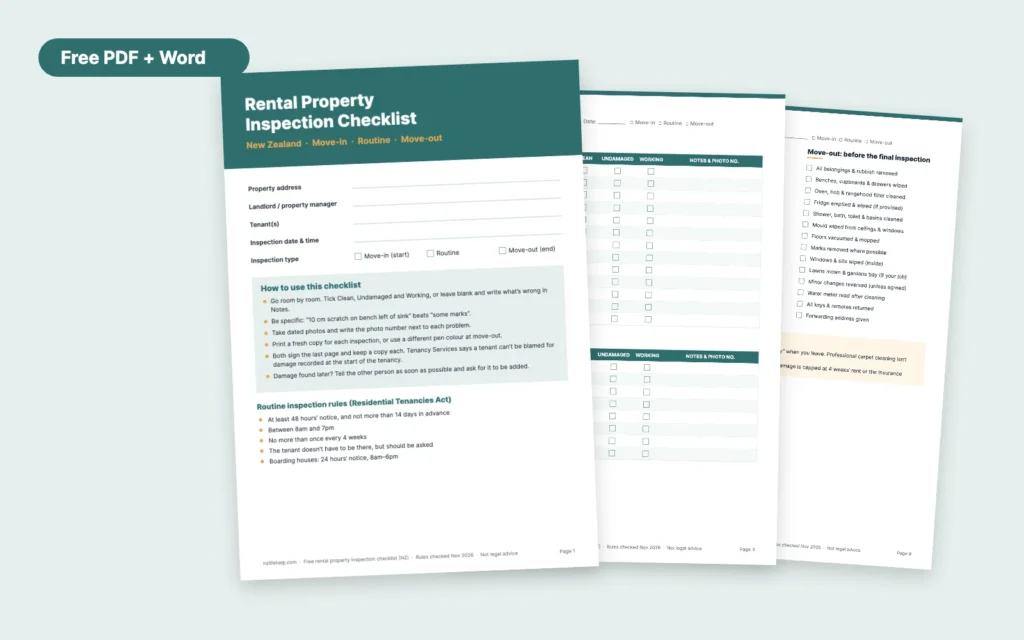
- Printable PDF (10 pages, A4): tick-box tables for 11 areas, from the entry and kitchen to the bathroom, laundry and outside, plus a safety and healthy homes section, keys and meter readings, a photo log, a routine inspection prep list, a move-out cleaning list and a sign-off page.
- Editable Word version: the same checklist with tables you can type into. Delete rooms you don’t have and add rows for anything extra, like a heat pump remote, sleepout or spa pool. Opens in Word, Google Docs, Pages and LibreOffice.
It works for tenants protecting their bond and for private landlords who want a clear record. Use it alongside the official property inspection report, which is part of Tenancy Services’ residential tenancy agreement template. Our tenancy agreement guide explains what else the agreement must include.
The three rental inspections in NZ
| Move-in | Routine | Move-out | |
|---|---|---|---|
| When | Start of the tenancy, before you unpack | During the tenancy, no more than once every 4 weeks | After you’ve moved out and cleaned |
| Who | Landlord and tenant, ideally together | Landlord or property manager; the tenant can choose to be there | Landlord and tenant, ideally together |
| Why it matters | Records existing damage so the tenant isn’t blamed for it later | Spots maintenance problems and damage early | Decides how much of the bond is refunded |
| Notice needed | Agree a time | At least 48 hours | Agree a time |
Move-in inspection: how to do it properly
Tenancy Services recommends that tenants and landlords check the property together at the start of the tenancy, record its condition and list any furniture or appliances included, then both sign, date and keep a copy of the report. This is the inspection that matters most, because everything at the end is compared against it.
- Do it before you move your stuff in. An empty house is much easier to check, and boxes can hide damage on floors and walls.
- Go room by room with the checklist. Look at walls, ceilings, floors, windows, curtains and fittings. Open every cupboard and drawer.
- Test everything that should work: lights, power points, oven, hob, rangehood, extractor fans, taps, the shower, toilet flush, heat pump and window catches. Press the test button on each smoke alarm.
- Write specific notes. “10 cm scratch on bench left of sink” is useful. “Some marks” isn’t.
- Take dated photos. Start each room with one wide shot, then close-ups of anything damaged. Write the photo number on the checklist so you can match them up.
- Compare with the landlord’s report. If something is missing or you disagree, write it on the report before you sign. Don’t sign anything you don’t agree with.
- Keep a copy of the signed report and your photos somewhere safe, such as an email to yourself or cloud storage.
Found more damage after you moved in? Tenancy Services says to tell the other person as soon as possible and ask for it to be added to the report. Some property managers give you a deadline to send back your notes (Barfoot & Thompson, for example, asks for its entry report within 14 working days), so check what yours says. If something needs fixing, a tenant can give the landlord a 14-day notice to remedy.
Moving into your first place? Pair this with our first apartment checklist, which includes a printable list of who to notify when you move.
Routine rental inspection NZ: the rules
Landlords are allowed to inspect during the tenancy, and some insurers require landlords to show that regular inspections are happening. But the Residential Tenancies Act sets limits. According to Tenancy Services:
| Rule | What it means |
|---|---|
| Notice | At least 48 hours’ notice, and not more than 14 days in advance |
| Time of day | Between 8am and 7pm |
| How often | No more than once every 4 weeks |
| Do you need to be home? | No, but the landlord should ask if you want to be there |
| Photos | Landlords should take photos, but avoid including your belongings where possible |
| Reinspection | Allowed with 48 hours’ notice if you agreed to fix or clean something by a certain date |
| Repairs (not an inspection) | At least 24 hours’ notice, between 8am and 7pm |
| Boarding houses | 24 hours’ notice for inspections, between 8am and 6pm |
Outside these rules, a landlord needs your permission to come inside, unless there’s an emergency such as a fire or flood, or a Tenancy Tribunal order.
What landlords look for
- The property is being kept reasonably clean and tidy
- Damage, and anything that needs repairing or maintaining
- Mould and dampness, especially in bathrooms and bedrooms
- Smoke alarms are still there and working
- Anything that doesn’t match the tenancy agreement, like extra occupants or an unapproved pet
How to prepare for a routine inspection as a tenant
You don’t need to deep clean for a routine inspection. Aim for “reasonably clean and tidy”. The printable checklist has a full prep list, but the main things are:
- Tell the landlord about anything that needs fixing in writing before the inspection, so there’s a record that you raised it
- Wipe away mould and condensation on windows and ceilings
- Clean the oven and rangehood filter, and empty the bins
- Make sure the landlord can get to every room, the meter and the heat pump
- Put away anything private you don’t want photographed
If you can’t be there, you can leave a note listing anything you want the landlord to look at.
Move-out inspection and getting your bond back
At the end of the tenancy, Tenancy Services says the property needs to be reasonably clean and tidy. Remove all your belongings and rubbish, leave behind anything the landlord provided, return all keys, and put back any minor changes you made (unless the landlord agrees they can stay). You don’t always have to get the carpet professionally cleaned, only if it’s needed to bring the property up to that standard, and a clause in your agreement saying you must may not be enforceable.
Do the final inspection after you’ve moved everything out and finished cleaning. If you pay for water, take the meter reading at that point too. If you can’t do the inspection together, you should each do your own and take photos.
When you get the full bond back
According to Tenancy Services, you get a full general bond refund if the property:
- is in reasonable condition and meets the tenancy agreement
- has no damage other than fair wear and tear
- doesn’t need any repairs
- has no money owing, such as rent or water charges
If money is owed, the landlord gets that amount from the bond and you get the rest. The maximum a landlord can charge is 4 weeks’ rent as a general bond, plus a pet bond of up to 2 weeks’ rent.
How the refund works now (Bond Hub)
Paper bond refund forms are no longer available from 29 June 2026. The landlord submits the refund request in Bond Hub (or their property management software), and you get a notification asking you to confirm the amounts. You have 12 working days to respond, and once all tenants agree, the bond is refunded the following day. Only accept the amount if you agree with it. If you can’t sort it out with the landlord, either of you can apply to the Tenancy Tribunal. If you both agree, you can ask for a mediator first.
Fair wear and tear vs damage
Tenants aren’t responsible for fair wear and tear, burglaries, or damage from natural events like storms, floods and earthquakes. If there’s a dispute, the landlord has to prove the damage isn’t fair wear and tear. If they can, the tenant then has to show it wasn’t intentional or careless. The examples below are typical, not legal definitions. The age and quality of the item matter too.
| Usually fair wear and tear | Usually the tenant’s responsibility |
|---|---|
| Carpet worn in walkways | Burns, large stains or pet damage on carpet |
| Faded curtains or paint from sun | Holes or marks from unapproved changes |
| Small scuffs from normal living | Broken windows or doors (if careless) |
| Loose handles or hinges from use | Mould left to spread after not airing the house |
| Old grout discolouring | Damage by guests |
For careless damage, the tenant’s liability is capped at 4 weeks’ rent or the landlord’s insurance excess, whichever is lower. Landlords can’t ask for more than that. For intentional damage, the landlord can ask the tenant to repair it or pay the full cost of repair or replacement.
Safety and healthy homes items to check
Smoke alarms must be within 3 metres of each bedroom door or in every room where someone sleeps, and on each level of a multi-storey home. Landlords must make sure they work at the start of each tenancy. Tenants must not remove or disconnect them, must replace dead batteries in older alarms that have replaceable batteries, and must tell the landlord about any problems.
It’s also worth checking the things the healthy homes standards cover: a fixed heater in the main living room, extractor fans in the kitchen and bathroom, no obvious draughts, and no mould or damp. These are all in the safety section of the checklist.
Common rental inspection mistakes
- Signing the move-in report without reading it, or leaving it until later
- Photos with no dates, or photos you can’t find two years later
- Writing vague notes like “good condition” for every room
- Not reporting repairs in writing during the tenancy
- Doing the final clean after the final inspection instead of before
- Accepting a bond refund amount in Bond Hub that you don’t agree with
Sharing a flat? If you’re not all named on the tenancy agreement, also read our guide to flatmate agreements in NZ, and check what’s included in rent before you sign.
FAQs
How often can a landlord do a rental inspection in NZ?
No more than once every 4 weeks. A reinspection is allowed with 48 hours’ notice if you agreed to fix or clean something by a certain date.
How much notice does a landlord have to give for an inspection?
At least 48 hours, and not more than 14 days in advance. Inspections can only happen between 8am and 7pm (8am to 6pm in boarding houses, which need 24 hours’ notice).
Do I have to be home for a rental inspection?
No. The landlord should ask if you want to be there. If you can’t be, leave a note listing anything you want checked.
Can a landlord take photos during an inspection?
Yes. Tenancy Services says landlords should take photos in case of a dispute, but should avoid including your belongings where possible.
Is there an official property inspection report in NZ?
Yes. Tenancy Services’ property inspection report is part of its residential tenancy agreement template, and there’s a fillable PDF version on tenancy.govt.nz. Our checklist goes into more detail room by room and can be used alongside it.
Do I have to get the carpets professionally cleaned when I move out?
Not always. The property needs to be reasonably clean and tidy. Professional cleaning is only needed if that’s what it takes to reach that standard, and a clause requiring it may be unenforceable.
What if I find damage after the move-in inspection?
Tell the landlord as soon as possible, in writing, with photos, and ask for it to be added to the inspection report.
New to renting in New Zealand? Start with our complete guide to renting in NZ.
This guide is general information, not legal advice. Rules checked against Tenancy Services in November 2026. For your situation, call Tenancy Services on 0800 836 262.
Sources
- Inspections – Tenancy Services
- Initial property inspection – Tenancy Services
- Access – Tenancy Services
- Damage and repairs – Tenancy Services
- Tenants – ending a tenancy process – Tenancy Services
- Refunding a general bond – Tenancy Services
- How to apply for a bond refund – Tenancy Services
- Smoke alarms in rental properties – Tenancy Services
- How to complete your entry inspection report – Barfoot & Thompson

Written by Alex · Founder, NZ Life Help
Alex moved to New Zealand from the UK in 2019 and has lived in Auckland and the South Island. He started NZ Life Help in 2026 to give newcomers and locals the clear, practical answers he couldn’t find when he arrived. Guides are checked against official sources and updated when the rules change.