Updated 12 November 2026. Rules checked against Tenancy Services, including the pet rules that started on 1 December 2025. General information, not legal advice.
Tenancy agreement NZ, the quick answer: a tenancy agreement must be in writing, and the landlord must give the tenant a signed copy before the tenancy starts. It has to include both parties’ names and addresses for service, the property address, start date, rent, bond and chattels, plus three signed statements: healthy homes, insulation and insurance. Tenancy Services publishes a free official residential tenancy agreement template (PDF). Use it with our free checklist below to make sure nothing is missing before anyone signs.
A tenancy agreement is the contract that sets out what a landlord and tenant have agreed. Most problems later on, about bond, pets, carpets or notice, trace back to something that was missing or unlawful in the agreement. This guide explains what must be in it, which clauses don’t count, the money limits, and where to get the official template.
Free tenancy agreement template NZ (and our checklist)
For the agreement itself, use the official version. Tenancy Services offers a free residential tenancy agreement template (PDF), which includes the property inspection report, and an online residential tenancy agreement builder that lets landlords create and customise an agreement. Landlords can also write their own, as long as it includes the minimum information the law requires. We haven’t made our own agreement because the official one is free, kept up to date when the law changes, and accepted everywhere.
What we have made is a free two-page checklist to use alongside it: one page for tenants to check before signing, and one for landlords covering the minimum requirements.
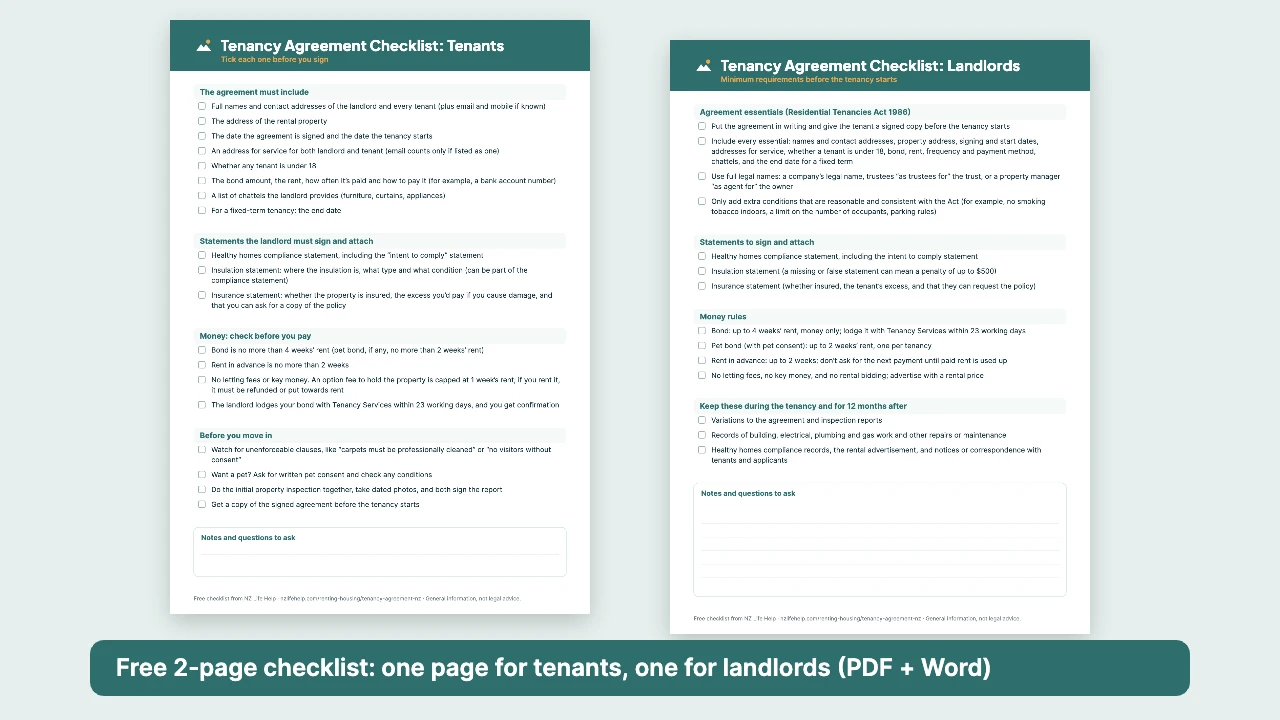
What a tenancy agreement must include
According to Tenancy Services, every residential tenancy agreement must include:
- The full names and contact addresses of the landlord and every tenant (plus email addresses and mobile numbers if known)
- The address of the rental property
- The date the agreement is signed and the date the tenancy begins
- An address for service for both landlord and tenant (an email address can be added as an extra address for service)
- Whether any tenant is under 18
- The bond amount
- The rent, how often it’s paid, and how it will be paid (for example, a bank account number)
- A list of any chattels the landlord provides, such as furniture, curtains and appliances
- For a fixed-term tenancy, the date it ends
- A signed healthy homes compliance statement
Even without a written agreement, the Residential Tenancies Act 1986 still applies and both sides still have to follow it. Not sure whether you want a fixed term or periodic tenancy? Our guide to renting in NZ explains the difference, and our notice to end a tenancy guide covers how each one ends.
Statements landlords must attach
Landlords need to sign and attach these statements to all new tenancy agreements:
- Healthy homes compliance statement: details of the property’s current level of compliance with the healthy homes standards, plus an “intent to comply” statement confirming the landlord complies or will comply from the start of the tenancy. It’s required for most new, renewed or varied agreements.
- Insulation statement: whether there’s insulation, where it is (ceiling, underfloor, walls), what type it is and its condition. It can be part of the compliance statement. A landlord who leaves it out or includes something they know is false could face a penalty of up to $500.
- Insurance statement: whether the property is insured, the excess a tenant would pay if they cause damage, and a note that tenants can ask for a copy of the insurance policy.
The official Tenancy Services template already includes the intent to comply statement, and Tenancy Services has separate templates for the compliance and insurance statements.
Bond, rent in advance and fees: the limits
| Payment | The rule |
|---|---|
| General bond | Up to 4 weeks’ rent, and only money (no credit card details, bank access or personal items as security). The landlord must lodge it with Tenancy Services within 23 working days of receiving it. |
| Pet bond | Only with pet consent. Up to 2 weeks’ rent, and only one per tenancy, however many pets. Charging more can mean a penalty of up to $3,000. |
| Rent in advance | Up to 2 weeks. The landlord can’t ask for the next payment until the rent already paid is used up. |
| Letting fees | Banned. Landlords and agents can’t charge tenants letting fees, including to renew or extend a tenancy. |
| Key money | Banned, except an option fee of up to 1 week’s rent to hold a property while you decide. If you go ahead, it must be refunded or put towards rent. |
Landlords also can’t invite or encourage rental bidding, and must advertise properties with a rental price.
Extra conditions: what landlords can and can’t add
Landlords can add conditions that are reasonable and generally consistent with the Act. Tenancy Services gives examples such as:
- No smoking tobacco products indoors (smoking in an outbuilding such as a garage, shed or carport is allowed)
- No subletting
- A limit on how many people can live there
- Rules about where cars can be parked
- Certain rules about pets
Clauses that are likely to be unenforceable
Conditions that ask more of tenants than the Act does, reduce tenants’ rights or try to get around the Act have no effect, and some can be an unlawful act. Tenancy Services lists these as likely unenforceable:
| Clause | Why it doesn’t work |
|---|---|
| Carpets must be professionally cleaned at the end | Tenants only have to leave the place reasonably clean and tidy (but see pets below) |
| Tenants must replace stove elements, fuses and tap washers | Landlords must keep the property in a reasonable state of repair |
| Tenants must give more than 21 days’ notice on a periodic tenancy | The Act sets 21 days |
| Rent can go up with 1 week’s notice | The Act sets the process for rent increases |
| No visitors or parties without the landlord’s consent | It breaches the tenant’s right to quiet enjoyment |
| The tenant pays fixed water charges | Landlords pay fixed water charges |
| The tenant must install smoke alarms | Landlords must install smoke alarms and keep them working |
| No smoking outside or in outbuildings | Smoking tobacco outside or in outbuildings is allowed |
Pets (rules from 1 December 2025)
If a tenant wants to start keeping a pet on or after 1 December 2025, they must ask the landlord for pet consent. A landlord who declines needs reasonable grounds, or could face a financial penalty. If they agree, they can set reasonable conditions, which can be in the tenancy agreement or the written response. Tenancy Services gives examples such as a pet bond of up to 2 weeks’ rent, professional carpet cleaning at the end if the pet is allowed indoors, and keeping the pet restrained when the landlord lawfully enters. Different rules apply to pets the landlord approved before 1 December 2025.
Who should be on the agreement
- People: full legal names. Landlords should check tenants’ identity before they move in.
- Companies: the legal company name, which may differ from the trading name.
- Trusts: the trustees’ names and the trust name, for example “Jane and Mary Brown as trustees for the Brown Family Trust”.
- Property managers: both the owner and the property management company, for example “Smith Property Management as agent for Andrew Jones”. If the owner isn’t named, the property manager takes on all the landlord’s responsibilities.
- Guarantors: a landlord can ask for a guarantor, for example for a tenant aged 17 or under or a first-time renter. They must be 18 or older and sign the tenancy agreement.
- Flatmates who aren’t named as tenants aren’t covered by the Act. Use a flatmate agreement for them.
Signing, copies and changes
- Electronic signatures are valid if both landlord and tenant agree to use them.
- The landlord must give the tenant a copy of the signed agreement before the tenancy starts.
- Landlords must keep variations, inspection reports, repair and healthy homes records, the advertisement and correspondence during the tenancy and for 12 months after it ends.
- To change a fixed-term agreement, the landlord and all the tenants must agree. Put any change in writing and keep a copy each.
Before you sign: tips for tenants
- Read the whole agreement, including any extra conditions, and ask for advice on anything you don’t understand.
- Check the healthy homes, insulation and insurance statements are attached and signed. Note the insurance excess you’d be liable for.
- Check the bond and rent in advance are within the limits, and that you’re not being charged a letting fee.
- Do the initial inspection together, take dated photos, and both sign the report. Our rental inspection checklist has a room-by-room version.
- Know what the rent covers. See what’s included in rent in NZ and our rent costs by city.
FAQs
Does a tenancy agreement have to be in writing in NZ?
Yes. Tenancy agreements must be in writing, and the landlord must give the tenant a copy of the signed agreement before the tenancy starts. Even without a written agreement, the Residential Tenancies Act 1986 still applies.
Where can I get a free tenancy agreement template in NZ?
Tenancy Services publishes a free residential tenancy agreement template (PDF), which includes the property inspection report, and an online tenancy agreement builder for landlords.
What statements must be attached to a tenancy agreement?
A healthy homes compliance statement (including an intent to comply statement), an insulation statement and an insurance statement, all signed by the landlord.
How much bond can a landlord charge in NZ?
Up to 4 weeks’ rent for a general bond, plus a pet bond of up to 2 weeks’ rent if the landlord has given pet consent. The landlord must lodge the bond with Tenancy Services within 23 working days.
How much rent in advance can a landlord ask for?
No more than 2 weeks. It’s unlawful to ask for more, and the landlord can’t ask for the next payment until the rent already paid has been used up.
Can a landlord make me get the carpets professionally cleaned?
Generally no. Tenancy Services lists this as likely unenforceable, because tenants only need to leave the property reasonably clean and tidy. The exception is a reasonable pet consent condition where a pet is allowed indoors.
Can a landlord say no pets in NZ?
Since 1 December 2025, tenants can ask for pet consent, and a landlord who declines needs reasonable grounds. If they agree, they can set reasonable conditions such as a pet bond of up to 2 weeks’ rent.
Are flatmates covered by the tenancy agreement?
Only people named as tenants are covered by the Residential Tenancies Act. Flatmates who aren’t on the agreement should have a separate flat-sharing agreement with the head tenant.

Written by Alex · Founder, NZ Life Help
Alex moved to New Zealand from the UK in 2019 and has lived in Auckland and the South Island. He started NZ Life Help in 2026 to give newcomers and locals the clear, practical answers he couldn’t find when he arrived. Guides are checked against official sources and updated when the rules change.