Updated 12 November 2026. Notice periods and service rules checked against Tenancy Services. General information, not legal advice.
Notice to end a tenancy in NZ, the quick answer: on a periodic tenancy, a tenant must give at least 21 days’ written notice. A landlord must give 90 days’ notice, or 42 days’ for a few specific reasons that must be written in the notice. To end a fixed-term tenancy on its end date, either side must give notice between 90 and 21 days before it ends, otherwise it rolls over into a periodic tenancy. The notice period starts the day after the notice is received, so add delivery time. Free Word letters for every situation are below.
Getting the notice wrong is one of the easiest ways to end up paying an extra week or two of rent, or having to start the whole process again. Most mistakes come down to three things: the wrong notice period, forgetting delivery time, and sending it somewhere that doesn’t count as an address for service. This guide covers the rules for tenants and landlords, shows you how to work out the last day, and gives you six free letter templates you can edit in Word or Google Docs.
Free notice to end tenancy templates (Word)
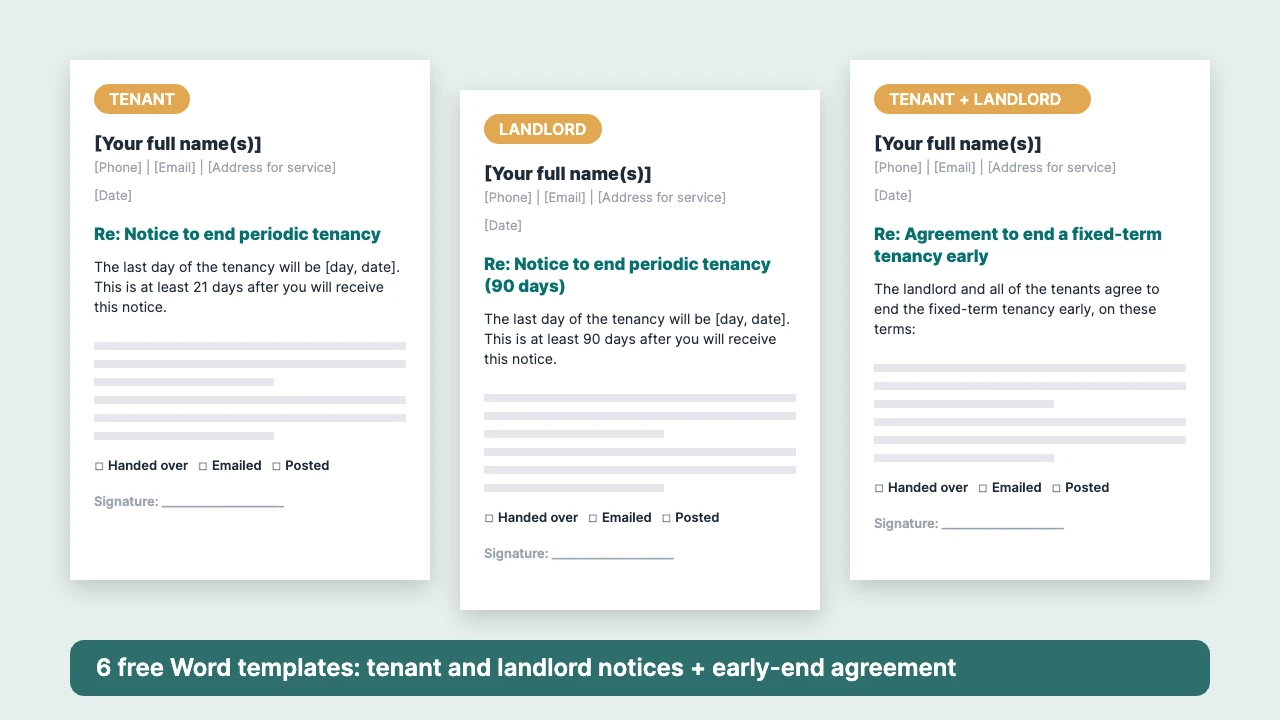
For tenants
For landlords
For both
Every letter includes the four things a notice must contain, signature lines and a “how this notice is being delivered” tick box so you can work out when it counts as received. Each one ends with a short before-you-send checklist page to delete before sending. The early-end agreement is for when the landlord and all the tenants agree to finish a fixed term early. It isn’t a notice, because neither side can end a fixed term early on their own.
Tenancy Services also publishes official notice templates. Ours cover the same legal requirements, add the delivery and date-counting help, and include the early-end agreement, which the official set doesn’t have.
How much notice to end a tenancy in NZ
These are the main notice periods under the Residential Tenancies Act 1986. All notice periods are counted in calendar days.
| Situation | Who | Notice needed |
|---|---|---|
| Periodic tenancy | Tenant | At least 21 days in writing (less only if the landlord agrees in writing) |
| Periodic tenancy, no reason | Landlord | At least 90 days in writing |
| Periodic tenancy, specific reason (family moving in, unconditional sale with vacant possession, staff housing) | Landlord | At least 42 days, with the reason stated in the notice |
| Fixed term, ending on the end date | Either | Notice received no more than 90 and no less than 21 days before the end date. No reason needed |
| Fixed term, ending early | Either | Can’t be done by notice. Needs agreement, an assignment, or a Tenancy Tribunal order |
| Fixed term of 90 days or less | Either | No notice needed. It ends on the expiry date |
| Family violence withdrawal | Tenant | At least 2 days, using the approved form with qualifying evidence |
| Physical assault by the tenant (charge filed) | Landlord | At least 14 days, using the approved form |
| Build-to-rent 10-year tenancy | Tenant | 56 days |
Renting a room in a boarding house? The notice periods are different: see ending a boarding house tenancy. Not on the tenancy agreement at all? Then you’re a flatmate, the Act doesn’t cover you, and the notice is whatever your flatmate agreement says.
Tenant notice to end a tenancy
Periodic tenancy: 21 days
If your tenancy has no end date, you can give notice at any time, even before the tenancy starts, as long as you give at least 21 days’ written notice. Notice can be given on any day of the week, to end on any day of the week. It doesn’t have to line up with the day you pay rent.
- Your landlord gave you 90 days’ notice but you’ve found a place sooner? You can leave earlier by giving them at least 21 days’ written notice.
- Flatmates on the agreement, take note: if several tenants are named on a periodic tenancy agreement, notice from any one of them ends the tenancy for all of them. Talk to the others before you send anything.
- Rent is due up to and including the last day of the tenancy.
Fixed-term tenancy: notice in the 90 to 21 day window
A fixed term doesn’t just end on its own. If you want to move out on the end date, your landlord must receive your written notice no more than 90 days and no less than 21 days before the fixed term ends. Miss that window, and the tenancy automatically becomes periodic when the fixed term finishes. You can still leave, but you’ll then need to give 21 days’ notice, which can mean an extra three weeks of rent.
The exception is a fixed term of 90 days or less. That ends on the agreed date without anyone giving notice.
Leaving a fixed term early
Generally, neither a tenant nor a landlord can give notice to end a fixed-term tenancy early. Your options are:
- Agree it with your landlord. The landlord and all the tenants must agree, preferably in writing (use our early-end agreement template). The landlord can charge a fee, but Tenancy Services says it should only cover their actual and reasonable costs, such as advertising for new tenants.
- Assign the tenancy to someone else. Landlords must consider every assignment request and must not unreasonably decline it. They can set reasonable conditions.
- Sublet, if your landlord agrees.
- Apply to the Tenancy Tribunal if continuing would cause you severe hardship, or after an unexpectedly large rent increase. The Tribunal may order compensation to the other side.
- Family violence: a tenant can withdraw from any tenancy, fixed-term or periodic, with at least 2 days’ written notice in the approved form, without penalty and without the landlord’s agreement. See Tenancy Services’ family violence withdrawal page.
Landlord notice to end a tenancy
90 days, no reason needed
A landlord can end a periodic tenancy with at least 90 days’ written notice without giving a reason. The tenant can still leave sooner with 21 days’ notice of their own.
42 days for specific reasons
A landlord can give 42 days’ notice instead, but only for one of these reasons, and the reason must be stated in the notice:
- The owner or a member of their family needs the property as their main home within 90 days after the tenancy ends, and will live there for at least 90 days.
- The property is usually used for the landlord’s employees or contractors (or was bought for that), this is clearly stated in the tenancy agreement, and it’s needed for that use.
- The property has been sold under an unconditional sale and purchase agreement that requires vacant possession.
- The landlord is the Ministry of Education and the property is needed for school board staff or contractors, as stated in the tenancy agreement.
If none of these apply, it’s 90 days. A conditional sale isn’t enough, and you may not need to end the tenancy at all: a rental can be sold with tenants in place. Tenants must give permission before buyers are shown through.
Fixed term: same 90 to 21 day window
Landlords who don’t want to continue after a fixed term must make sure the tenant receives written notice between 90 and 21 days before it ends. No reason is needed. Miss the window and the tenancy becomes periodic, so you’d then need 90 days’ notice (or 42 days for a listed reason).
What landlords can’t do
- Give retaliatory notice. Ending a tenancy because a tenant stood up for their rights, for example by complaining or asking for repairs, is an unlawful act. The Tenancy Tribunal can set the notice aside and award exemplary damages of up to $6,500. Tenants have 12 months to apply.
- Change the locks or remove a tenant who won’t leave. Apply to the Tenancy Tribunal for a possession order instead. If a tenant stays more than 90 days after the tenancy ends without the landlord getting a possession order, a new periodic tenancy is created and you have to start again.
What every notice must include
Every notice to end a tenancy must:
- be in writing
- give the address of the tenancy
- give the date the tenancy ends
- be signed by the person giving the notice.
Send it to the other person’s address for service, as written in the tenancy agreement (or as updated since). Email, text or a messaging app only counts if that electronic address is listed in the agreement as an address for service. A Facebook message to a landlord who never gave you their Messenger as an address for service doesn’t count. Not sure what’s in yours? See what a tenancy agreement must include.
How to work out the last day of your tenancy
Two rules decide your end date. First, a notice only counts once it has been received, and the law sets how long that takes. Second, the notice period starts the day after it’s received.
| How you deliver it | When it counts as received |
|---|---|
| Handed over in person | Immediately |
| Emailed (or texted) to the address for service before 5pm | The same day |
| Emailed to the address for service after 5pm | The next working day |
| Put in the letterbox or clearly attached to the door | 2 working days after delivery |
| Posted | The 4th working day after posting |
Tenancy Services gives the first two examples below for a tenant’s 21-day notice, in a week with no public holidays. The third follows the same rules:
- Posted on Friday 1 August: received Thursday 7 August, notice period starts Friday 8 August, tenancy ends Thursday 28 August.
- Put in the letterbox on Friday 1 August: received Tuesday 5 August, period starts Wednesday 6 August, tenancy ends Tuesday 26 August.
- Handed over on Friday 1 August: received the same day, so the 21 days start on Saturday 2 August and the tenancy can end on Friday 22 August.
The quickest valid method is handing it over or emailing an address for service before 5pm. Posting is the slowest and can cost you almost a week.
Giving notice over Christmas and New Year
This catches lots of people out every summer. Service times are counted in working days, and the Christmas–New Year period isn’t made of working days. Tenancy Services’ own example: a notice posted on Monday 22 December might not count as received until Wednesday 7 January, which pushes a 21-day tenancy end out to 28 January. If you’re giving notice in December, hand it over or email it to the address for service rather than posting it. Planning ahead? Our 2027 public holidays list has the dates.
After the notice: moving-out checklist
- Pay rent up to and including the last day. Don’t just stop paying and expect the bond to cover it unless your landlord agrees.
- Book the final inspection. Ideally after you’ve moved everything out and cleaned. Take dated photos and compare against the move-in report. Our rental inspection checklist has a room-by-room move-out list.
- Leave it reasonably clean and tidy and take your rubbish. Professional carpet cleaning isn’t always required, even if the agreement says so.
- Take final meter readings (water and power) after you’ve finished cleaning, and cancel or move your power and internet.
- Return all keys and anything the landlord supplied.
- Sort the bond in Bond Hub. The landlord starts the refund and you confirm it. You’ll need your tenant number (format Tenant-12345678). Only accept the amount if you agree with it. More in our guide to renting in NZ.
- Update your address everywhere it matters. See our moving house checklist: who to notify.
Common mistakes
- Counting from the day you send it. The period starts the day after it’s received, and posting adds 4 working days.
- Ending a fixed term with 21 days’ notice “any time”. 21 days is only for periodic tenancies. Fixed terms need notice in the 90–21 day window, for the end date only.
- Missing the fixed-term window and getting stuck on a periodic tenancy with another 21 days to pay.
- Sending a text or DM to a number or account that isn’t an address for service.
- A landlord using 42 days without one of the listed reasons, or without writing the reason in the notice.
- One flatmate giving notice without realising it ends the periodic tenancy for everyone on the agreement.
- No proof of delivery. Keep a copy, the sent email, or a photo of the letter in the letterbox.
Still not sure? Tenancy Services has a short “how much notice” tool, or call them on 0800 836 262. For disagreements, mediation and the Tenancy Tribunal are the next steps. New to renting here? Start with our complete guide to renting in New Zealand.
Posting your notice close to Christmas? A posted notice only counts as received on the fourth working day after posting, and tenancy law doesn’t count 24 December to 3 January as working days. Our working days calculator has a tenancy setting that works out the date for you.
FAQs
How much notice does a tenant have to give in NZ?
On a periodic tenancy, at least 21 days’ written notice, unless the landlord agrees in writing to less. On a fixed-term tenancy, you can only end it on the end date, with notice received between 90 and 21 days before that date.
Can I give notice to end my tenancy by email or text?
Yes, but only if that email address or phone number is listed in the tenancy agreement as an address for service. Sent before 5pm, it counts as received the same day. After 5pm, it counts from the next working day.
Does the day I give notice count as day one?
No. The notice period starts the day after the notice is received. If you post it, it isn’t received until the 4th working day after posting.
Can my landlord end my tenancy without a reason?
For a periodic tenancy, yes, with at least 90 days’ written notice, as long as it isn’t retaliatory. For a fixed term, the landlord can choose not to continue after the end date by giving notice between 90 and 21 days before it ends.
If one tenant gives notice, does it end the tenancy for everyone?
On a periodic tenancy, yes. Tenancy Services says notice from one of the tenants named on the agreement ends the tenancy for all tenants.
What happens if nobody gives notice before a fixed term ends?
The tenancy automatically becomes periodic. After that, a tenant needs to give 21 days’ notice and a landlord 90 days (or 42 days for a listed reason). Fixed terms of 90 days or less are the exception: they simply end.
Can my landlord charge me for breaking a fixed-term lease?
Only if you both agree to end it early. Tenancy Services says any fee should only cover the landlord’s actual and reasonable costs, such as advertising for new tenants.
Can I move out before the 90 days my landlord gave me?
Yes. Give your landlord at least 21 days’ written notice and the tenancy ends on your date instead.

Written by Alex · Founder, NZ Life Help
Alex moved to New Zealand from the UK in 2019 and has lived in Auckland and the South Island. He started NZ Life Help in 2026 to give newcomers and locals the clear, practical answers he couldn’t find when he arrived. Guides are checked against official sources and updated when the rules change.