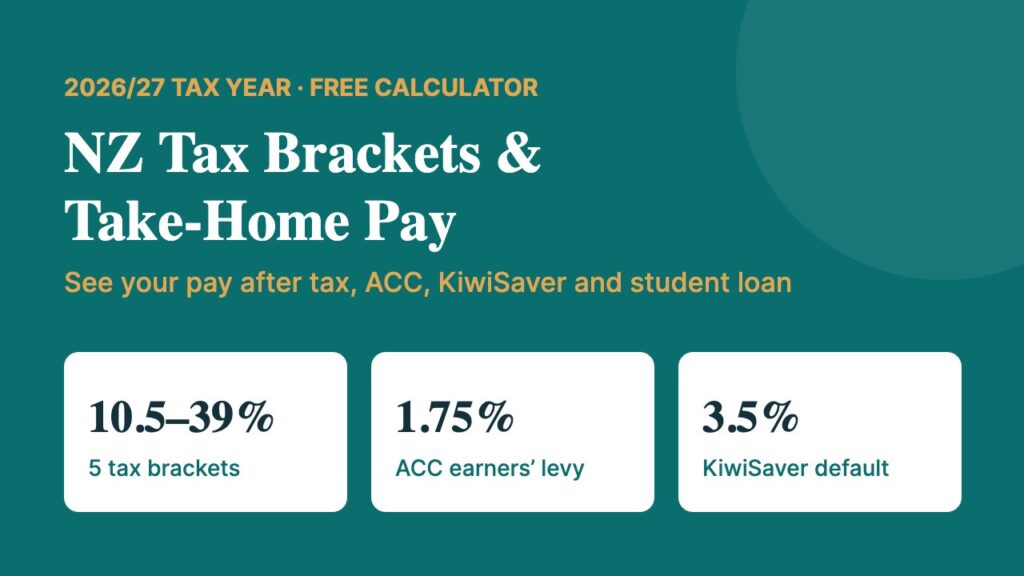
Income tax in New Zealand is set nationally, so the same rates apply whether you live in Auckland, Invercargill or anywhere in between. There is no regional or city income tax. For the 2026/27 tax year (1 April 2026 to 31 March 2027) the NZ tax brackets run from 10.5% to 39%, and on top of that your pay has the ACC earners’ levy taken out, plus KiwiSaver and student loan if they apply to you.
Quick answer: On a $70,000 salary you take home about $1,021 a week ($4,425 a month) after income tax, ACC and 3.5% KiwiSaver. Without KiwiSaver it’s about $1,068 a week. Put your own numbers into the calculator below.
NZ take-home pay calculator (2026/27)
For pay days from 1 April 2026 to 31 March 2027. Main job, tax code M or ME. Same rules everywhere in New Zealand.
Estimate only, using IRD’s 2026/27 rates: income tax brackets, ACC earners’ levy of 1.75% (on earnings up to $156,641), student loan 12% over $24,128 a year, and the IETC. Your payslip may differ by a few cents because payroll works pay by pay. It does not cover secondary tax codes, child support, Working for Families, or tax on income that isn’t wages. Your employer’s KiwiSaver contribution is paid on top of your pay and is taxed (ESCT) before it reaches your account.
NZ tax brackets for 2026/27
These are the rates for individuals on their main income. The thresholds haven’t changed since they were raised in July 2024, and they are the same for 2026/27 as they were for 2025/26.
| Taxable income | Tax rate | Total tax if you earn the top of this band |
|---|---|---|
| $0 – $15,600 | 10.5% | $1,638 |
| $15,601 – $53,500 | 17.5% | $8,270.50 |
| $53,501 – $78,100 | 30% | $15,650.50 |
| $78,101 – $180,000 | 33% | $49,277.50 |
| $180,001 and over | 39% | – |
New Zealand has no tax-free threshold. You pay 10.5% from your first dollar of income.
A higher bracket never cuts your take-home pay
Each rate only applies to the dollars inside that band. If a pay rise takes you from $78,000 to $79,000, only the $900 above $78,100 is taxed at 33%. Everything below stays taxed at the lower rates, so you always keep more of a pay rise than you had before it.
How your pay is worked out: a $70,000 example
Here’s how the NZ tax brackets work out for someone on $70,000 a year, tax code M, in KiwiSaver at the default 3.5%, with no student loan.
| Step | Calculation | Amount |
|---|---|---|
| Tax on the first $15,600 | $15,600 × 10.5% | $1,638.00 |
| Tax on $15,601 – $53,500 | $37,900 × 17.5% | $6,632.50 |
| Tax on $53,501 – $70,000 | $16,500 × 30% | $4,950.00 |
| Total income tax | $13,220.50 | |
| ACC earners’ levy | $70,000 × 1.75% | $1,225.00 |
| KiwiSaver | $70,000 × 3.5% | $2,450.00 |
| Take-home pay | $70,000 − all of the above | $53,104.50 |
Your effective rate is 20.6% (income tax plus ACC, divided by your pay), even though your top rate is 30%. This is why “I’m in the 30% bracket” sounds worse than it really is.
What else comes out of your pay
ACC earners’ levy: 1.75%
Every employee pays the ACC earners’ levy, which funds cover for injuries outside work. For 2026/27 it’s 1.75% (up from 1.67%), charged on earnings up to $156,641. The most anyone pays is $2,741.22 a year. Inland Revenue has already published the next rate: 1.83% from 1 April 2027.
Your employer takes the levy out together with your PAYE, so most payslips show one combined figure. That’s why IRD lists PAYE rates like 19.25% or 31.75%: they’re the tax rate plus 1.75% ACC.
KiwiSaver: 3.5% by default
The default employee rate went from 3% to 3.5% on 1 April 2026, and your employer has to match it with at least 3.5% on top of your pay. You can choose 4%, 6%, 8% or 10% instead. If 3.5% is too much right now, you can apply to IRD for a temporary rate reduction to 3% for 3 to 12 months. The default goes up again to 4% on 1 April 2028.
KiwiSaver doesn’t reduce your income tax. It’s taken from your gross pay, but you’re still taxed on the full amount. Your employer’s contribution is taxed too (employer superannuation contribution tax, or ESCT) before it reaches your account.
Student loan: 12% over $24,128
If you have a student loan and live in New Zealand, you repay 12 cents of every dollar you earn over $24,128 a year. Per pay, that threshold is $464 a week, $928 a fortnight or $2,010.66 a month. The Government has frozen the threshold at $24,128 for the foreseeable future. On a second job there’s no threshold, so 12% comes off every dollar.
Independent earner tax credit (IETC)
If you earn between $24,000 and $70,000, you may get up to $520 a year back ($10 a week). It reduces by 13 cents for every dollar over $66,000, so it’s gone completely at $70,000. You can’t get it if you (or your partner) receive Working for Families, or if you get a main benefit, NZ Super or a Veteran’s Pension. To get it in each pay, use tax code ME instead of M. Otherwise it’s sorted out after the end of the tax year.
Take-home pay on common salaries
All figures are for 2026/27, tax code M or ME, 3.5% KiwiSaver, no student loan. Rounded to the nearest dollar.
| Salary | Per year | Per month | Per fortnight | Per week |
|---|---|---|---|---|
| $30,000* | $24,787 | $2,066 | $953 | $477 |
| $40,000* | $32,512 | $2,709 | $1,250 | $625 |
| $50,000* | $40,237 | $3,353 | $1,548 | $774 |
| $60,000* | $47,150 | $3,929 | $1,813 | $907 |
| $65,000* | $50,387 | $4,199 | $1,938 | $969 |
| $70,000 | $53,104 | $4,425 | $2,042 | $1,021 |
| $80,000 | $59,522 | $4,960 | $2,289 | $1,145 |
| $90,000 | $65,698 | $5,475 | $2,527 | $1,263 |
| $100,000 | $71,872 | $5,989 | $2,764 | $1,382 |
| $120,000 | $84,222 | $7,019 | $3,239 | $1,620 |
| $150,000 | $102,748 | $8,562 | $3,952 | $1,976 |
| $200,000 | $133,181 | $11,098 | $5,122 | $2,561 |
Not in KiwiSaver? Add 3.5% of the salary back. For example, $100,000 with no KiwiSaver leaves you $75,372 a year, or about $1,449 a week. For salary ranges by job and region, see our guide to the average salary in New Zealand.
Hourly pay: what you take home for a 40-hour week
Same assumptions as above (3.5% KiwiSaver, no student loan, IETC where you qualify), 40 hours a week for 52 weeks.
| Hourly rate | Yearly gross | Take-home per week | Take-home per month |
|---|---|---|---|
| $23.95 (adult minimum wage) | $49,816 | $771 | $3,341 |
| $25 | $52,000 | $804 | $3,482 |
| $30 | $62,400 | $937 | $4,059 |
| $35 | $72,800 | $1,056 | $4,576 |
| $40 | $83,200 | $1,183 | $5,125 |
| $50 | $104,000 | $1,430 | $6,195 |
More on rates, part-time hours and who can be paid less in our minimum wage guide.
Tax codes: make sure yours is right
Your tax code tells your employer how much to deduct. The wrong code is the most common reason people pay too much, or get a bill at the end of the year.
| Tax code | Use it for |
|---|---|
| M | Your main (or only) job |
| ME | Main job, if you qualify for the IETC |
| M SL / ME SL | Main job, with a student loan |
| SB | Second job, if your total yearly income is $15,600 or less (10.5%) |
| S | Second job, total income $15,601 – $53,500 (17.5%) |
| SH | Second job, total income $53,501 – $78,100 (30%) |
| ST | Second job, total income $78,101 – $180,000 (33%) |
| SA | Second job, total income over $180,000 (39%) |
| ND | No tax code or IRD number given to your employer: 45% plus ACC |
If you’re new to New Zealand, get your IRD number sorted before your first pay. Without it, you’ll be taxed at the 45% no-notification rate. Here’s how to get an IRD number.
Why your payslip might not match
- You’re on the wrong tax code, or a secondary code on what is really your main job.
- Your pay changes week to week. Payroll treats each pay as if you earned that amount all year, so a big week (overtime, a bonus, holiday pay) is taxed at a higher rate. It usually evens out when IRD checks your income after 31 March.
- Rounding. Payroll works pay by pay, so you may see a few cents’ difference from a yearly calculation like ours.
- Other deductions such as child support, a union fee or salary sacrifice.
After the tax year ends, IRD works out whether you paid the right amount. If you paid too much (common if you only worked part of the year), you’ll get a refund.
Self-employed or a contractor?
This calculator is for wages and salaries. Contractors on schedular payments (tax code WT) choose their own withholding rate (at least 10% for most), and ACC invoices them directly instead of taking it from each payment. Sole traders pay income tax at the same rates, but through a tax return and provisional tax. If you bill clients, our free NZ invoice template covers what you need to include. If you’re GST-registered, our GST calculator adds or removes the 15% for you.
Is tax different in Auckland?
No. The NZ tax brackets, ACC levy and KiwiSaver rates are the same anywhere in the country. What changes is how far your take-home pay goes, and rent is the biggest factor. Compare cities in our cost of rent breakdown and see where the rest goes in our cost of living guide.
Got children? You may also get Working for Families tax credits on top of your take-home pay. Our Working for Families calculator estimates the family tax credit, in-work tax credit and Best Start for 2026/27.
Frequently asked questions
Is income tax the same everywhere in New Zealand?
Yes. Income tax, the ACC earners’ levy, KiwiSaver and student loan rates are set nationally, so you pay the same in Auckland, Wellington, Christchurch or a small town. There is no regional or city income tax. What differs between places is the cost of living, especially rent.
How much tax do I pay on $100,000 in NZ?
For 2026/27, income tax on $100,000 is $22,877.50 and the ACC earners’ levy is $1,750. That leaves $75,372.50 a year (about $1,449 a week) before KiwiSaver, or $71,872.50 (about $1,382 a week) with 3.5% KiwiSaver.
How much is $70,000 a year after tax per week?
About $1,068 a week after income tax and ACC, or about $1,021 a week if you also pay 3.5% into KiwiSaver. That assumes tax code M, no student loan and 52 weeks of pay.
Will a pay rise push me into a higher bracket and leave me with less?
No. Each tax rate only applies to the part of your income inside that band. If a pay rise moves you into the 33% bracket, only the dollars above $78,100 are taxed at 33%, so you always keep more than before.
Is there a tax-free threshold in New Zealand?
No. Unlike Australia or the UK, New Zealand taxes income from the first dollar. The lowest rate is 10.5% on income up to $15,600.
Does KiwiSaver reduce my income tax?
No. Your KiwiSaver contribution comes out of your gross pay, but you are still taxed on the full amount. Your employer’s contribution is paid on top and has employer superannuation contribution tax (ESCT) taken off before it goes into your account.
Why is my payslip different from the calculator?
Usually it’s your tax code, a pay that was higher than normal (overtime, a bonus or holiday pay is taxed as if you earned that much all year), or other deductions such as child support. Small differences of a few cents come from payroll rounding each pay.
Sources
- Inland Revenue: tax rates for individuals
- Inland Revenue: ACC earners’ levy rates
- Inland Revenue: KiwiSaver changes
- Inland Revenue: repaying your student loan from salary or wages
- Inland Revenue: about tax codes
Last checked 12 November 2026 against Inland Revenue’s 2026/27 rates. This is general information, not tax advice. For your own situation, check with IRD or a tax adviser.

Written by Alex · Founder, NZ Life Help
Alex moved to New Zealand from the UK in 2019 and has lived in Auckland and the South Island. He started NZ Life Help in 2026 to give newcomers and locals the clear, practical answers he couldn’t find when he arrived. Guides are checked against official sources and updated when the rules change.