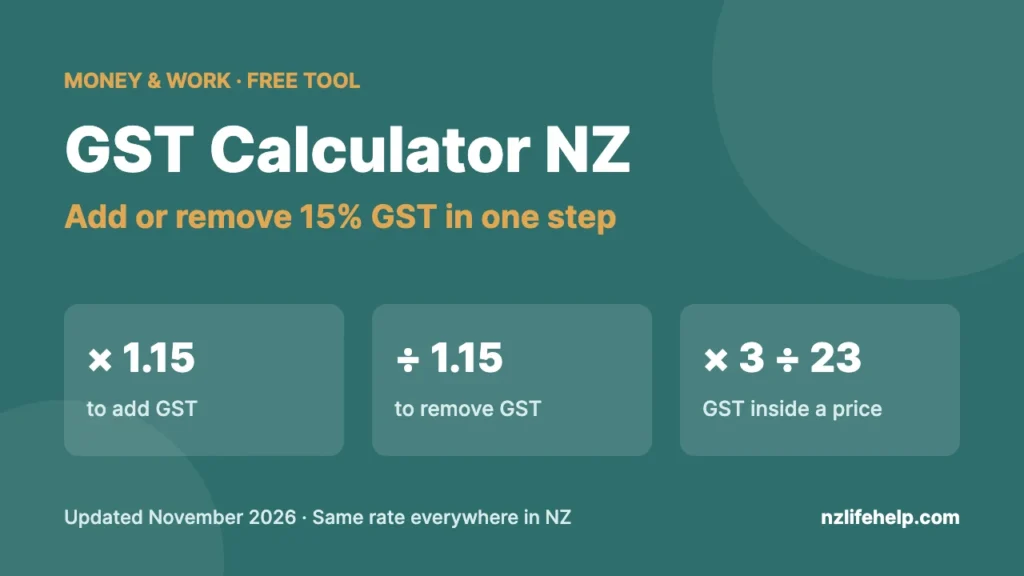
This GST calculator NZ tool adds or removes New Zealand’s 15% GST in one step and shows the working, so you can check a quote, an invoice or a receipt. GST is a flat 15% everywhere in the country, from Kaitaia to Bluff, and it applies to most goods and services.
Quick answer: To add GST, multiply by 1.15 ($100 + GST = $115). To remove GST from a GST-inclusive price, divide by 1.15 ($115 ÷ 1.15 = $100). To find just the GST inside an inclusive price, multiply by 3 and divide by 23 ($115 × 3 ÷ 23 = $15).
GST calculator NZ (15%)
Add GST to a price, or take it out of a GST-inclusive price. Works the same everywhere in New Zealand.
Got several amounts? Add them up here
Type or paste one amount per line (for example from an invoice or a list of receipts). The add/remove setting above applies to every line.
GST is rounded to the nearest cent on each amount. Rate: 15%, as set by Inland Revenue (unchanged since 1 October 2010). This tool is a quick check, not tax advice.
How to calculate GST in NZ
There are only four sums you ever need. Here they are with a $200 example:
| What you want | Formula | Example |
|---|---|---|
| Add GST to a price | price × 1.15 | $200 × 1.15 = $230 |
| The GST to add | price × 0.15 | $200 × 0.15 = $30 |
| Remove GST from an inclusive price | price ÷ 1.15 | $230 ÷ 1.15 = $200 |
| The GST inside an inclusive price | price × 3 ÷ 23 | $230 × 3 ÷ 23 = $30 |
Why 3/23?
A GST-inclusive price is made up of 115 parts: 100 parts price and 15 parts GST. So the GST share is 15/115, which simplifies to 3/23, or about 13.04%. Inland Revenue uses this example: $100 including GST contains $13.04 of GST (3/23 of $100), so the price without GST is $86.96.
The mistake almost everyone makes
Taking 15% off a GST-inclusive price does not remove the GST. $115 minus 15% is $97.75, not $100, because the 15% was worked out on the smaller, GST-exclusive amount. On a $11,500 invoice, that slip puts you $225 out. Divide by 1.15 instead, or use the calculator.
GST quick reference table
Handy if you just need a ballpark. The last two columns are for prices that already include GST.
| Amount | Plus GST | GST inside (if incl.) | Excl. GST (if incl.) |
|---|---|---|---|
| $10.00 | $11.50 | $1.30 | $8.70 |
| $20.00 | $23.00 | $2.61 | $17.39 |
| $50.00 | $57.50 | $6.52 | $43.48 |
| $100.00 | $115.00 | $13.04 | $86.96 |
| $200.00 | $230.00 | $26.09 | $173.91 |
| $500.00 | $575.00 | $65.22 | $434.78 |
| $1,000.00 | $1,150.00 | $130.43 | $869.57 |
| $5,000.00 | $5,750.00 | $652.17 | $4,347.83 |
Are prices in New Zealand shown with GST?
In shops, cafés and online stores selling to the public, yes: the price on the tag is normally the price you pay. The Commerce Commission’s guidance is that prices must include, or be clear about, the 15% GST, and any surcharges must be made clear before you buy.
Business-to-business pricing is different. Tradies, accountants, wholesalers and contractors often quote “+ GST”, so a $2,000 quote for a bathroom repaint can turn into a $2,300 bill. If a quote doesn’t say, ask whether it includes GST before you accept it.
Visiting from overseas? New Zealand has no tourist GST refund scheme, so visitors pay GST just like locals. Your options are airport duty-free shops, or having a retailer ship goods straight to an overseas address (exported goods can be sold without GST). Planning a trip? Our guide to the cost of living in New Zealand gives a feel for everyday prices.
Do you need to register for GST?
Not every business charges GST. According to Inland Revenue, you must register if you carry out a taxable activity (a business, trade or similar) and either:
- your turnover was at least $60,000 in the last 12 months, or you expect it to be at least $60,000 in the next 12 months, or
- you add GST to the price of the goods or services you sell.
Below $60,000, registration is optional. Registering lets you claim back the GST on business costs (handy if you’ve just bought expensive tools or a work vehicle), but you then have to charge GST and file returns. If you’re not registered, don’t add GST to your invoices. If you do, IRD treats that as a reason you must register.
Once registered, you choose how often to file and which accounting basis to use:
| Filing frequency | Who can use it |
|---|---|
| Monthly | Anyone (compulsory if sales are over $24 million in 12 months) |
| 2-monthly | Sales under $24 million |
| 6-monthly | Sales under $500,000 |
The payments basis (you account for GST when money actually changes hands) is available if your sales are $2 million or less. The invoice basis is open to anyone and counts sales when you invoice, even if you haven’t been paid yet.
Will the $60,000 threshold change? It hasn’t moved since 2009. During the 2026 election campaign, National said it would review it and Labour proposed lifting it to $80,000 from 1 July 2028. Neither is law, and the final election results aren’t due until 27 November 2026, so for now the threshold is still $60,000. We’ll update this page if that changes.
Just starting out? You’ll need an IRD number before anything else, so here’s how to get an IRD number. Freelancing alongside a job? See our guide to remote jobs you can do from New Zealand.
When GST isn’t 15%
Most things are taxed at 15%, but Inland Revenue lists a few groups that work differently:
- Zero-rated (0%): GST applies but the rate is 0%. Exported goods and services are the common example, and selling a business as a going concern can be too.
- Exempt: no GST at all. Residential rent and financial services such as interest on loans are exempt, which is why your weekly rent has no GST in it.
- Land sales have their own rules. IRD’s guide IR730 covers them, and it’s worth talking to an adviser.
Commercial rent is different from residential rent: if the landlord is GST-registered, GST is usually added. Renting a home? Our guide to what’s included in rent in NZ explains the rest.
GST on things you buy from overseas
- Goods worth $1,000 or less: since 1 December 2019, overseas sellers registered for NZ GST charge 15% at the checkout. Customs doesn’t normally collect duty or GST on these at the border, except for alcohol and tobacco or when they’re part of a larger consignment over $1,000.
- Goods worth more than $1,000: Customs collects GST (and any duty) at the border before releasing them. GST is worked out on the value of the goods plus freight, insurance and duty, so it’s more than 15% of the sticker price. Levies and broker fees can apply too.
- Digital services such as streaming, apps and online subscriptions from overseas companies have had 15% GST since 1 October 2016.
Check that the checkout shows GST on overseas orders. If it does, you shouldn’t be charged it a second time at the border.
Putting GST on an invoice
GST-registered businesses have to give “taxable supply information” for sales over $200 when the buyer asks. Between $200 and $1,000 that means your name and GST number, the date, a description, and the amounts (or the GST-inclusive total with a statement that it includes GST). Over $1,000, you also need the buyer’s name and an identifier. Our free NZ invoice template has GST and non-GST versions in Word and Excel that do the sums for you.
Rounding and the odd cent
The calculator rounds GST to the nearest cent on each amount. If you add up a long list, rounding each line can give a total that’s a cent or two different from working out GST on the grand total. Both approaches are common, and accounting software usually lets you choose. What matters is being consistent.
GST is only one tax on your money. For income tax, ACC and KiwiSaver on your wages, try our NZ take-home pay calculator.
Frequently asked questions
What is the GST rate in New Zealand?
GST in New Zealand is 15%, and has been since 1 October 2010. It is the same rate everywhere in the country and applies to most goods and services. A few things are zero-rated (such as exports) or exempt (such as residential rent and interest on loans).
How do I work out the GST from a total that includes GST?
Multiply the total by 3 and divide by 23. For example, $230 × 3 ÷ 23 = $30 of GST. To get the price without GST, divide the total by 1.15 ($230 ÷ 1.15 = $200).
What is $100 plus GST in NZ?
$100 plus GST is $115, of which $15 is GST. If a price is $100 including GST, it contains $13.04 of GST and the price without GST is $86.96.
Why can’t I just take 15% off to remove GST?
Because GST is 15% of the GST-exclusive price, not of the total. Taking 15% off $115 gives $97.75 instead of the correct $100. Divide by 1.15 instead.
Can I charge GST if I’m not GST-registered?
No. Only GST-registered businesses can charge GST. Inland Revenue says that if you add GST to your prices, you must register. Registration is compulsory once your turnover reaches $60,000 in 12 months.
Do tourists get a GST refund in New Zealand?
No. New Zealand has no tourist GST refund scheme, so visitors pay GST like everyone else. You can avoid GST by shopping duty-free at the airport, or by having a retailer ship goods directly to an overseas address.
Is there GST on rent in New Zealand?
Not on residential rent, which is an exempt supply. Commercial rent is different: if the landlord is GST-registered, GST is usually added to the rent.
Sources
- Inland Revenue: registering for GST
- Inland Revenue: charging GST
- Inland Revenue: GST accounting basis and filing frequency
- Inland Revenue: GST on low-value imported goods
- NZ Customs: information for importers (2026 goods levies)
- Commerce Commission: pricing
- Xero: GST registration threshold in 2026
Last checked 15 November 2026 against Inland Revenue guidance. This is general information, not tax advice. For your own situation, check with IRD or a tax adviser.

Written by Alex · Founder, NZ Life Help
Alex moved to New Zealand from the UK in 2019 and has lived in Auckland and the South Island. He started NZ Life Help in 2026 to give newcomers and locals the clear, practical answers he couldn’t find when he arrived. Guides are checked against official sources and updated when the rules change.