Updated 8 November 2026. Dates follow the rule set by the Department of Internal Affairs and were checked against the official time zone database.
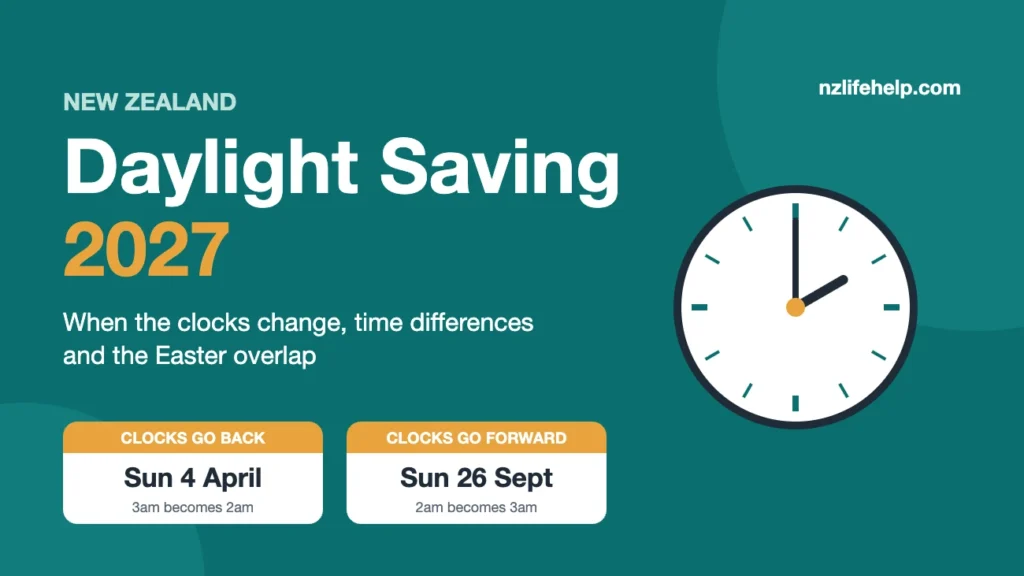
Daylight saving NZ 2027, the quick answer: daylight saving ends on Sunday 4 April 2027 at 3am, when clocks go back one hour to 2am, so you get an extra hour’s sleep. It starts again on Sunday 26 September 2027 at 2am, when clocks go forward to 3am. Phones and computers change automatically, but older clocks, ovens and car clocks need changing by hand.

Daylight saving in New Zealand runs from the last Sunday in September to the first Sunday in April. Here are the exact dates for 2027 and the next few years, what happens on the night, how the change lines up with Easter and the school holidays, and how it affects the time difference with Australia, the UK, the US and Asia.
On this page
Daylight saving NZ 2027 and future dates
| Summer | Starts (clocks forward 1 hour) | Ends (clocks back 1 hour) |
|---|---|---|
| 2026/27 | Sunday 27 September 2026 | Sunday 4 April 2027 |
| 2027/28 | Sunday 26 September 2027 | Sunday 2 April 2028 |
| 2028/29 | Sunday 24 September 2028 | Sunday 1 April 2029 |
| 2029/30 | Sunday 30 September 2029 | Sunday 7 April 2030 |
What happens on the night the clocks change
| When daylight saving ends (April) | When daylight saving starts (September) | |
|---|---|---|
| Time of change | 3:00am becomes 2:00am | 2:00am becomes 3:00am |
| Clocks go | Back one hour | Forward one hour |
| Sleep | One hour more | One hour less |
| Evenings | Darker earlier | Lighter for longer |
| Time zone | Back to NZST (UTC+12) | Switches to NZDT (UTC+13) |
The easy way to remember it is “spring forward, fall back”. In New Zealand, spring is September and autumn is April. If you’d rather not think about it at 2am, change your manual clocks before bed on Saturday night.
Chatham Islands
The Chatham Islands are 45 minutes ahead of mainland New Zealand all year. They change at the same moment as the mainland, which is 2:45am local time in September and 3:45am in April.
Does daylight saving clash with Easter in 2027?
Not this time. Easter 2027 falls on 26–29 March, so the clocks go back the following weekend, on Sunday 4 April.
- In 2026, daylight saving ended on Easter Sunday itself (5 April), which caught out plenty of people heading to Easter services and family lunches.
- In 2029, it will happen again: the clocks go back on Easter Sunday, 1 April 2029.
- School holidays: the clocks go back on 4 April 2027, the weekend before the Term 1 school holidays start (Saturday 10 April). That gives kids a week to adjust before the holiday break. See our NZ school holidays 2027 guide.
Planning time off? Our public holidays NZ 2027 guide has every public holiday and long weekend.
Time differences: NZ and the rest of the world
Because different countries change their clocks on different dates, or not at all, the time difference with New Zealand shifts during the year. Here’s how far ahead New Zealand is:
| City | NZ summer (Nov 2026 – mid-Mar 2027) | NZ winter (5 Apr – 25 Sep 2027) |
|---|---|---|
| Sydney / Melbourne | 2 hours | 2 hours |
| Brisbane | 3 hours | 2 hours |
| Perth | 5 hours | 4 hours |
| Singapore / Manila / Beijing | 5 hours | 4 hours |
| Tokyo | 4 hours | 3 hours |
| India | 7.5 hours | 6.5 hours |
| London | 13 hours | 11 hours |
| New York | 18 hours | 16 hours |
| Los Angeles | 21 hours | 19 hours |
| Rarotonga (Cook Islands) | 23 hours (Rarotonga’s clock is 1 hour later, but a day behind) | 22 hours (2 hours later on the clock, a day behind) |
Watch out for the in-between weeks. Around the changeovers, differences are briefly unusual:
- Australia (Sydney, Melbourne, Canberra, Hobart): for one week after NZ’s clocks go forward, NZ is 3 hours ahead (26 September – 3 October 2027), until Australia changes on the first Sunday in October. Both countries go back on the same April Sunday. Queensland doesn’t have daylight saving at all.
- UK: 12 hours between NZ starting daylight saving and the UK ending its summer time (26 September – 31 October 2027), and again from the UK’s spring change until NZ’s April change (28 March – 4 April 2027).
- US: because the US changes its clocks on different dates, New York is 17 hours and Los Angeles 20 hours behind for several weeks in March–April and October–November.
Working with overseas colleagues or calling family abroad? Put a world clock on your phone. Our remote jobs guide has more tips for working across time zones, and if you’re planning a Pacific trip, see our Rarotonga guide.
Do I need to change my clocks?
- Automatic: smartphones, computers, smart watches and most internet-connected devices change themselves.
- Manual: car clocks, ovens, microwaves, older alarm clocks, heat pump timers and some security systems need changing by hand.
- Check your alarms on Sunday morning if you have an early flight, shift or event.
Good habit: the Department of Internal Affairs suggests that while you’re changing your clocks, it’s a good time to check your smoke alarms, emergency plans and survival kits. Do it twice a year, every time the clocks change.
Shift work, travel and sleep
- Night shifts: if you work overnight when the clocks change, your shift is one hour shorter in September and one hour longer in April. How that’s paid depends on your employment agreement, so check with your employer or payroll.
- Flights and buses: timetables use local time, so an early Sunday departure is at the new time.
- Medication: if you take medication at set times, ask your pharmacist how to adjust.
- Kids and pets: shifting bedtimes and meals by 10–15 minutes a day in the few days before the change makes the switch easier.
- Driving: after the April change, evening commutes get dark earlier, so check your headlights. Our NZ road rules guide has more safety tips.
Why New Zealand has daylight saving
Daylight saving moves an hour of summer daylight from the early morning, when most people are asleep, to the evening, when it’s more useful. New Zealand first introduced it in 1927, and dropped it in the mid-1940s, when standard time was moved forward half an hour all year instead. The one-hour summer change returned in 1974. In 2007, daylight saving was extended by three weeks to today’s period, from the last Sunday in September to the first Sunday in April. The Department of Internal Affairs looks after daylight saving. For what summer here is actually like, see our New Zealand weather guide.
FAQs
When does daylight saving end in NZ in 2027?
Sunday 4 April 2027 at 3am, when clocks go back one hour to 2am. You get an extra hour of sleep.
When does daylight saving start in NZ in 2027?
Sunday 26 September 2027 at 2am, when clocks go forward one hour to 3am.
Do the clocks go forward or back in April in NZ?
Back. In April daylight saving ends and clocks go back one hour. In September they go forward.
Is daylight saving on Easter weekend in 2027?
No. Easter 2027 is 26–29 March, and daylight saving ends the following Sunday, 4 April. In 2026 it ended on Easter Sunday, and it will again in 2029.
What time zone is New Zealand in?
New Zealand Standard Time (NZST) is UTC+12. During daylight saving, New Zealand Daylight Time (NZDT) is UTC+13. The Chatham Islands are 45 minutes ahead.
What is the time difference between NZ and Australia?
NZ is 2 hours ahead of Sydney and Melbourne for most of the year, and 3 hours ahead for about a week in late September and early October. Brisbane is 3 hours behind NZ in summer and 2 hours in winter.
What is the time difference between NZ and the UK?
NZ is 13 hours ahead of London during the NZ summer and 11 hours ahead during the NZ winter, with 12 hours for a few weeks around each changeover.
Will my phone change automatically for daylight saving?
Yes. Smartphones and computers update automatically. Car clocks, ovens and older clocks usually need changing by hand.
Sources
- Department of Internal Affairs – Daylight saving ends (April 2024 release)
- Department of Internal Affairs – Daylight saving time begins (2019 release, includes history)

Written by Alex · Founder, NZ Life Help
Alex moved to New Zealand from the UK in 2019 and has lived in Auckland and the South Island. He started NZ Life Help in 2026 to give newcomers and locals the clear, practical answers he couldn’t find when he arrived. Guides are checked against official sources and updated when the rules change.